Tuesday, May 6, 2014

"For a Season Hell Laughed While Zion Wept" - Seymour's Brigade, Morning May 6


The soldier does not live who can ever forget his emotions on going into a battle.[1]
 
While Colonel J. Warren Keifer spent the night of May 5th/6th drifting into and out of fanciful dreams at the third division's field hospital, the survivors of Seymour's brigade had little chance for rest. "At night we slept with our guns in our hand," recalled Lorenzo D. Barnhart of Company B, 110th Ohio. "We could not sleep well, the country being so desperate and God forsaken, that we hoped we would not get killed.... None of us wished to die here."[1]

Osceola Lewis of the 138th Pennsylvania vividly remembered the eerie atmosphere as night covered the landscape:
The troops slept on their arms that eventful night within one hundred yards of the enemy's pickets. The doleful cry of the "whippoorwill," the moans of the wounded between the two lines of skirmishers; the sharp challenge of sentinels on either side; the ominous click and sudden discharge of a musket where a "halt!" was disregarded,--were sounds heard which tended to create very solemn impressions.[2]
Once the bloody fire-fight waged by the 110th Ohio and 6th Maryland had sputtered out in the deepening darkness, the exhausted front line had fallen back about two hundred yards and the soldiers struggled to find what rest they could. Colonel William H. Ball and 200 soldiers of his 122nd Ohio were detailed to picket the front of the brigade. "Through the night the rebels were actively engaged in cutting timber, strengthening their works, and moving to our right," Col. Ball reported. "Brigadier-General Seymour...was repeatedly notified during the night and early morning of the 6th of the movements of the enemy."[3]

Judging from various accounts, Truman Seymour must not have gotten much sleep either. Not only did he receive repeated warnings from Col. Ball's picket line, his other regiments heard the sounds too. "The noise of axes and falling timber was heard along the enemy's line, for he was preparing to contest his position behind strong works," recollected a veteran of the 126th Ohio.[4] Colonel Matthew R. McClennan of the 138th also sent word of the ominous sounds in front and extending to the right. "I personally reported this fact to General Seymour and recommended him to take measures to prevent a flank attack," he later wrote.[6]

Toward morning, the brigade's second line relieved the fought-out 110th Ohio and 6th Maryland. From left to right the new main line ran 122nd Ohio - 138th Pennsylvania - 126th Ohio, with the two bloodied regiments in a supporting line. As first light approached, Seymour grappled with a difficult situation. Headquarters had instructed the Sixth Corps to resume the assault at 5 a.m. as part of a larger, army-wide movement. Yet, Seymour also knew the situation in his front, and his regimental officers had certainly expressed negative views of the prospects for a successful assault from their precarious position on the federal flank. In later years the officers of his brigade criticized Seymour for failing to alert his superiors of his situation. Yet there was likely little Seymour could do to change his orders.

The restless night came to an end around 4:30 a.m. with the roar of Confederate artillery. Richard Ewell had beaten John Sedgwick to the punch, and his rebel forces swarmed over their defenses and began to push the federal skirmish line back and to probe the main line, testing its strength. The rebel foray was beaten back with relative ease, and the combat for a time settled into a constant struggle between the two skirmish lines.[7] After a few hours of this back-and-forth, Seymour received renewed orders to push his attack. Despite repeated notifications from the regimental officers on the front lines that the Confederate works extended beyond the federal lines, somewhere along the chain of command there was still hope of turning Ewell out of his entrenchments. Sometime after 7 a.m., the orders went out to the 122nd, 138th, and 126th: attack at once. Osceola Lewis recalled:
This assault...had no promises of victory, for every man who bore his part in it, from the private soldier up to the Regimental commander, knew by the experiences of the previous night, and by the difficulties already met, that such an attack in such force, was next to madness. But trusting in the sagacity of General officers and hoping for success, despite of ill prospects, these men obeyed and struggled manfully.
Colonel Benjamin F. Smith
Col. McClennan and Col. Ball, of the 138th and 122nd, stood calmly at the center of their commands, while Col. Benjamin F. Smith of the 126th sat his horse directly behind the center of his line.[8] Francis Cordrey of Company E, 126th Ohio, later remembered hearing Smith's ringing command: "Fall in! Fix bayonets! Forward - Double-quick - March!" Cordrey's account continued:
Our lines moved forward, struggling through the natural abatis, while a blast of leaden hail from the enemy's thundering guns poured in the face of our advancing line; but nearer and nearer the Stars and Stripes were carried to that parapet of death.[9]
As the ragged lines crawled through the brambles and thickets, Col. Smith remained undisturbed on his horse behind the 126th, snapping his fingers and shouting "Give it to 'em boys!" Meanwhile, in the 138th Pennsylvania, the fire cut down men left and right. Color Sergeant Samuel Aikens had his hand mangled by a bullet and dropped the flag, only to have Sergeant Charles H. Fitzgerald of Company C seize it and plant it in the ground so that he could continue to fire away with his musket.[10] Cyrus G. Cook of Company G later recalled that nearly all the men on either side of him had been killed or wounded. When he looked to his left and right he could only find First Sergeant Nicholas G. Wilson and Corporal William Reed.[11]

The three regiments advanced to within one hundred yards of the Confederate line on the slope above. Sheets of flame erupted from behind the protective earthworks. "The enemy was found to be not only in strong number," Cordrey wrote,
but situated in a strong position, having in front of it a large log heap as long as its line.... These logs received our lead, while the bodies of our country's defenders received that of the enemy. For a season, hell laughed while Zion wept.[12]
Looking up the slight slope toward the Confederate works in the vicinity of where Seymour's brigade made their assault on the
morning of May 6th. You can access this ground today by hiking the NPS "Gordon's Flank Attack" trail.
The 126th Ohio's Lieutenant Colonel Aaron W. Ebright and acting adjutant Thomas J. Hyatt had their horses killed underneath them. For perhaps an hour the federal soldiers continued the unequal contest, making little headway but suffering dreadfully.[13] Eventually, the futility of further combat became apparent to Seymour, and he issued orders for his command to fall back to its starting position. In the retrograde movement, many of the dead and wounded of the three regiments were left in no-man's land between the lines. As Cyrus G. Cook fell back with the other survivors of his company, he noted that the underbrush, which had been impenetrable during the advance, had been completely shot away by Confederate fire.[14] 

The failed charge had cost Seymour's brigade dearly. It is difficult to state the casualty figures with exactitude, as the brigade's fight on May 6th was not over. But over the course of the day the 126th Ohio lost 23 men killed, 136 wounded and 70 missing; a total of 229 men out of a regiment that numbered 578 when it crossed the Rapidan. In the 138th, the casualty lists for the battle counted 27 killed, 94 wounded, 9 missing and 26 captured - a total of 165. The 122nd Ohio recorded 18 men killed, 111 wounded, 28 missing and 28 captured, a grand total of 185. Some of these casualties, particularly the high number of missing and captured, resulted from fighting on the evening of May 6th. Yet the proportion of the casualties that resulted from the morning's charge was undoubtedly high.[15]

After the war, many of the veterans of Seymour's brigade reflected bitterly on their experiences in the Wilderness, which many deemed a useless sacrifice. Colonel William H. Ball of the 122nd Ohio complained in his report that "in the assault my regiment had no support whatever." Meanwhile Osceola Lewis summed up the feelings of many--fairly or unfairly--when he pinned the blame on the man who had led the brigade for all of two days: "The same authority that governed the unlucky day at Olustee, and led the fruitless assault on Fort Wagner, conducted this handful of braves in the charge of May 6th against fortified thousands...."[16]

Seymour's brigade had now suffered bloody repulses twice on the right flank of the Army of the Potomac. As it withdrew to its lines to rest and recover, the men could not know that before the day was out they would feel a more stinging defeat, one coupled with despair and humiliation.

----------
[1] J.H. Gilson, Concise History of the 126th Regiment Ohio Volunteer Infantry (Salem Ohio: Walton, Steam Job and Label Printer, 1883), 32.
[2] Lorenzo D. Barnhart, The Reminiscences of Lorenzo D. Barnhart, Company B, 110th Ohio, available online at http://www.frontierfamilies.net/family/Wildenet.htm, accessed May 3, 2014.
[3] OR XXXVI Part 1, 745.
[4] Osceola Lewis, History of the 138th Pennsylvania Volunteer Infantry (Norristown, PA: Wills, Iredell & Jenkins, 1866), 84.
[5] Gilson, Concise History, 33.
[6] OR XXXVI Part 1, 751.
[7] Gordon Rhea, The Battle of the Wilderness: May 5-6, 1864 (Baton Rouge: LSU Press, 1994, 318-319);  Edward Steere, The Wilderness Campaign: The Meeting of Grant and Lee (Mechanicsburg, PA: Stackpole Books, 1960), 319-320.
[8] Lewis, History of the 138th, 85-86.
[9] Francis Cordrey, "The Wilderness: What a Private Saw and Felt in that Horrible Place," National Tribune, June 21, 1894.
[10] Lewis, History of the 138th, 85-86.
[11] "Personal Sketch of Cyrus G. Cook," Personal Sketches Presented to Corporal Skelly G.A.R. Post 9, Adams County Historical Society (1892), 51.
[12] Cordrey, "The Wilderness: What a Private Saw and Felt in that Horrible Place." NT, June 21, 1894.
[13] OR XXXVI Part 1, 748.
[14] Lewis, History of the 138th, 88; "Personal Sketch of Cyrus G. Cook," Personal Sketches.
[15] OR XXXVI Part 1, 748; Lewis, History of the 138th, 93; Moses Moorhead Granger, The Official War Record of the 122nd Regiment of Ohio Volunteer Infantry (Zanesville, Ohio: George Lilienthal, Printer, 1912), 70.
[16] OR XXVI Part I, 745; Lewis, History of the 138th, 90.

Saturday, May 3, 2014

Impossible to Succeed - Seymour's Brigade, May 5th 1864


Timothy O'Sullivan's photograph taken on May 4th shows the Army of the Potomac crossing the Rapdian at Germanna Ford from a ridge on the south side of the river. It was perhaps from this same vantage point that Colonel Keifer spoke with Major McElwain on the morning of May 5th.
Soldiers! The eyes of the whole country are looking with anxious hope to the blow you are about to strike in the most sacred cause that ever called men to arms.
- Circular published by Maj. Gen. George Gordon Meade, May 4, 1864

Colonel Joseph Warren Keifer rose early on May 5th, 1864. He and the soldiers of the 110th Ohio had slept without tents on the heights overlooking Germanna Ford. The uncomfortable sleeping arrangements mattered little. The third division of the Sixth Corps had covered 18 miles the day before, marching in the heat of a Virginia May. Several had come down with sunstroke; all were exhausted when their march concluded on the south bank of the Rapidan River. As the sun rose on May 5th, Keifer stood on a ridge overlooking the Rapidan crossing. The warmth of the early light gave warning that another hot day was in store.[1]

Joseph Warren Keifer
Before the war the twenty-eight year-old Colonel practiced law in Springfield, Ohio, where he was a staunch Republican. With little more than militia experience, Keifer rushed to volunteer in April of 1861, and received a commission as Major of the 3rd Ohio Volunteers. He saw action in George McClellan's West Virginia campaign of 1861, and rose to the rank of Lieutenant Colonel before receiving command of the 110th Ohio in September of 1862. The previous fall he had commanded his brigade at the Battle of Locust Grove, during the Mine Run campaign.[2]  

As Keifer gazed down upon the pontoon bridges floating in the river, his Major, William S. McElwain, approached. In a quiet, troubled tone, McElwain warned his commanding officer that, "unless I was more prudent than usual I would never recross [the river]," Keifer later recalled. As Keifer and McElwain reflected on the likelihood of impending combat, their soldiers brewed coffee and ate their breakfast. The third division had orders to defend the crossing site until the arrival of Ambrose Burnside's 9th Corps. A bit before 9 a.m., the troops got a glimpse of  Lieutenant General Ulysses S. Grant and his cavalcade of staff as it clattered by. "He was on a fine, though small, black horse, which he set well," Keifer remembered. He 
was plainly dressed, looked the picture of health, and bore no evidence of anxiety about him. His plain hat and clothes were in marked contrast with a somewhat gaily dressed and equipped staff. He saluted, spoke pleasantly, but did not check his horse from a rather rapid gait.
Grant's gait reflected an anxiety that his demeanor did not show. The commanding general had received word earlier that morning from Maj. Gen. George Gordon Meade that rebels had appeared in force west of Wilderness Tavern. Intending to await Burnside's arrival at Germanna Ford before moving to the front, Grant's patience had run thin, and he left written instructions for Burnside before breaking up his headquarters at the ford and moving to the front. As he departed, the commanding general ordered third division commander James B. Ricketts to push forward to Wilderness Tavern as soon as Burnside's lead elements crossed the river.[3]

Truman Seymour
While Grant passed on to investigate the opening salvos in the Wilderness, within the third division officers and soldiers alike attempted to sort out new command relationships. The division had been a part of the Sixth Corps for little more than a month. It had served under its new commander, Maj. Gen. James B. Ricketts, for even less time. And as they rested on the ridge above the Rapidan, the second brigade, which included Keifer's 110th Ohio, marked the arrival of a new commander, Brig. Gen. Truman Seymour. A career soldier and a graduate of the superb West Point Class of 1846, Seymour was not necessarily a stranger to the Army of the Potomac. He had commanded troops in combat as a brigade commander in the 5th Corps during the Seven Days, and had even led a division at Malvern Hill. He saw further action at 2nd Manassas, South Mountain (where his brigade captured Turner's Gap), and at Antietam. Passed up for permanent division command in the Army of the Potomac in the Fall of 1862, Seymour requested a transfer. He moved to Charleston, where he famously commanded the assault (led by the 54th Massachusetts) on Battery Wagner on July 18th, 1863. He was wounded in this attack, but recovered and in February 1864 found himself in command of Union forces at the Battle of Olustee in Florida, a disastrous defeat that tarnished his reputation. Seymour arrived to take command of the second brigade early on the morning of May 5th. The men of the 110th, 122nd, 126th Ohio, 6th Maryland, and 138th Pennsylvania would march into the Wilderness in a new corps, with a new division commander, and with a brigade commander whose association with his troops measured only hours.[4]

Shortly after Grant departed the scene, General Burnside arrived at the head of his corps, and General Ricketts began to put his troops on the Germanna Plank Road. The column had barely started when a courier arrived from Meade's headquarters bearing conflicting orders - Ricketts men were to picket the roads to the west of Germanna Ford, protecting the army's right flank. The campaign was just twenty-four hours old, and the Army of the Potomac's complicated command arrangements were already causing confusion. Ricketts possessed an order from Grant to march and an order from Meade to stay put. He halted his his troops, positioned them to protect the crossing site, and sought clarification from Army Headquarters. Finally, at about 1:30 in the afternoon Burnside's troops relieved Ricketts, and the division got started again on the Germanna Plank Road for a five mile march to the front. Up ahead, the soldiers could hear the reverberating sounds of combat as the 5th Corps engaged with the Army of Northern Virginia along the Orange Turnpike in Saunders Field.[5]

As the division arrived within supporting distance of those troops already engaged in the late afternoon, its two brigades were split up. Brig. Gen. William H. Morris's first brigade received orders to support the 5th Corps south of the Orange Turnpike, and a courier from 6th Corps commander John Sedgwick directed Seymour's command to report to Brig. Gen. Horatio Wright, whose division held the right of the Federal line north of the turnpike. Seymour's men turned onto the Culpeper Mine Road, marched to the extreme right of the Army of the Potomac, and formed into two lines of battle. Keifer's 110th Ohio and Colonel John  W. Horn's 6th Maryland held the first line, supported by the 122nd Ohio, 138th Pennsylvania, and the 126th Ohio.[6] The soldiers could hardly see 25 yards ahead in the foreboding wilderness, a second growth forest of scrub trees and dense underbrush that made the movement of organized lines virtually impossible. A veteran of the 126th Ohio recalled that the terrain entirely concealed the enemy from view. "Far, far in front stretched the blind, interminable forest," he wrote, "through which the eye vainly peered for an unseen foe."[7]

All day long, the high command of the Army of the Potomac had flailed about attempting to put together a coordinated attack against Lee's forces, failing time and again. As evening approached, Grant and Meade looked for one last opportunity. With Richard Ewell's Confederates continuing to frustrate frontal assaults of the 5th and 6th Corps, thoughts turned to locating the northern flank of Ewell's line in an effort to turn his strong entrenchments along the pike. The assignment fell to Seymour's men. After coming into position, Keifer and Horn both threw out a skirmish line to engage the enemy and ascertain their position and strength. As their soldiers sparred with unseen foes in the dense undergrowth, reports filtered in that Ewell was moving troops to reinforce Lee's southern flank. Assuming that the northern flank had been weakened, orders came down to push the assault against Ewell's lines.[8]

Truman Seymour had a difficult task on this day - to command soldiers whom he had barely met. Yet the sources indicate that Seymour did little to endear himself to his men. With orders to make a vigorous assault against the rebel flank, at about 6 p.m. Seymour directed Keifer to take command of the brigade's first line and lead the attack.[9]

Colonel Keifer led the 110th Ohio and 6th Maryland forward. The two regiments scrambled through the thickets and briars, pushing back Confederate skirmishers, until they came upon the main line of Ewell's defense. Keifer found the enemy "intrenched behind logs which had been hurriedly thrown together." Halting his advance, Keifer sought out Colonel Horn. The two regiments found themselves unsupported on both flanks. Keifer also found that, contrary to reports, Ewell's lines extended far beyond his own flank. He sent word to the rear of the impossibility of his task, but soon a courier arrived from Seymour with orders to attack at once. Believing that Seymour had not received his own message, Keifer did not immediately obey the order. But when a second courier arrived reiterating the message, the Ohio colonel had no choice. "It was impossible to succeed," Keifer would later report, but with no other options he ordered his line forward.[10]

The Ohioans and Marylanders advanced to within 150 yards of the Confederate earthworks at the top of the slope. A devastating fire poured into the regiments from the front and from both flanks, but they maintained the fire fight, believing that supporting troops might come up and strike the rebel flank. Lieutenant Colonel Otho Binkley of the 110th reported that "a rapid and destructive fire was kept up from both sides...until it became so dark that our aim had to be guided by the flash of the enemy's guns."[11]

Amidst the crashing discharges of musketry and the choking smoke, Keifer stood near the center of both regiments directing the affair. After about an hour a minie ball struck the Colonel's left forearm, passing through both bones, but he fought on with his men. Shortly there after, a major on horseback materialized out of the smoke. It was William S. McElwain of the 110th, reporting that the men of his regiment were falling fast and couldn't maintain the fight. Keifer shouted above the pandemonium to McElwain to tell his men that support was on its way. The major swung his horse around to return, but in that moment the horse fell dead. "The Major, lighting on his feet," Keifer later recalled, 
disappeared among the scrub pines. He was never seen again, nor his body found. He must have been killed, and his body consumed by the great conflagration which, feeding upon the dry timber and debris, swept the battlefield, licking up the precious blood and cremating the bodies of the martyred dead.[12]
Shortly after his encounter with Major McElwain, Keifer relinquished command to seek treatment. After several hours of an unequal contest, and multiple protests from officers at the front about a lack of support, Seymour finally issued orders for his troops to pull back in the darkness. Late that night, Keifer was born back on a stretcher to a field hospital. "I had seen something of war," he wrote, "but, for the first time, my lot was now cast with the dead, dying, and wounded."[13] A member of the 10th Vermont, of the division's first brigade, witnessed Keifer's arrival:
He came in hatless and pantsless. He had nothing on except a pair of heavy army shoes, a pair of indescribable colored socks, such as were issued by the Quartermaster, a shirt bloody from top to bottom, and a vest buttoned close around him. His right arm was terribly shattered, hanging at his side, while in his left hand he held his good sword. All this, with his long tangled hair--for he was a Nazarite, sworn not to cut his hair or beard until Richmond fell--gave him a most weird appearance. When or how he came no one knew; and when the surgeon kindly asked him if he would have his wound dressed, he replied, with an expression of mingled wrath and grief: "I should not care for myself if the rascals had not cut my poor men to pieces."[14]
As he was carried into a tent, Keifer noticed the large pile of legs and arms that flanked its entrance. "The surgeons," he wrote, "with gleaming, sometimes bloody, knives and instruments, were busy at their work." Surgeons Charles E. Cady of the 138th Pennsylvania and Theodore A. Helwig of the 87th Pennsylvania attended to Keifer, cutting to the fractured ends of his shattered forearm bones, dressing them with saw and knife, and setting them again. "The sensation produced by the anesthetic, in passing to and from unconsciousness," he wrote, "was exhilarating and delightful. For some hours, exhausted from loss of blood as I was, I fell into short dozes, accompanied with fanciful dreams." As an afterthought, Keifer added: "Not all have the same experience."[15]

Colonel Keifer's writings long after the war reflect the bitterness he still maintained for the folly of the assault order on the evening of May 5th. Both regiments suffered heavy losses. The 110th counted 113 casualties, while the 6th Maryland suffered 180.[16] Colonel Keifer's Battle of the Wilderness was over. From the field hospital on May 7th, the Colonel joined the immense wagon train of wounded traveling to Fredericksburg. There he was confined for ten days in the home of Sarah Ann French Alsop, before moving on to Washington and home. An infection in his wounded arm threatened Keifer's life for a time, but he would eventually recover and return to the army.[17]

For many other members of the 2nd brigade, the battle of the Wilderness was just beginning.

--------------


1. Joseph Warren Keifer, Slavery and Four Years of War: A Political History of Slavery in the United States Together with a Narrative of the Campaigns and Battles of the Civil War in which the Author Took Part: 1861-1865, Volume II (New York: G.P. Putnam’s Sons, 1900), 78; Diary of Elias N. Hartzell, Elias N. Hartzell file, Adams County Historical Society.

2. Keifer, S&FYOW  Volume II, 250-255.

3. Ibid., 78. Edward Steere, The Wilderness Campaign: The Meeting of Grant and Lee (Mechanicsburg, PA: Stackpole Books, 1960), 120-122; OR Part I, 371.

4. OR XXXVI Part 2, 735.

5. OR XXXVI Part 1, 722.

6. OR XXXVI Part 1, 730.

7. J.H. Gilson, Concise History of the One Hundred and Twenty-sixth Regiment Ohio Volunteer Infantry (Salem Ohio: Walton, Steam Job and Label Printer, 1883), 32.

8. OR XXXVI Part 1, 728; Gordon Rhea, The Battle of the Wilderness: May 5-6, 1864 (Baton Rouge: Louisiana State University Press, 1994), 243-245.

9. OR XXXVI Part 1, 731.

10. Ibid.

11. OR XXXVI Part 1, 741.

12. Keifer, S&FYOW Volume II, 84-85.

13. Ibid., 294.

14. E.M. Haynes, A History of the Tenth Regiment, Vermont Volunteers (Lewiston, ME: Journal Steam Press, 1870), 64-65.

15. Keifer, S&FYOW Volume II, 85-86.

16. OR XXXVI Part 1, 728.

17. Keifer, S&FYOW Volume II, 86.

Friday, May 2, 2014

News and Notes - May 2014

It's been about a month folks, but new blog posts are coming. In a few days I'll have a few posts to roll out in my continuing series on the 3rd Division of the 6th Corps (formerly known as "French's Pets"). These posts will focus on the division's actions during the Battle of the Wilderness - timed as you might have guessed to coincide with the 150th anniversary of that battle.

A few other items you might want to read in the meantime:

- Over at the Fredericksburg and Spotsylvania National Military Park's excellent blog Mysteries and Conundrums, Chief Historian John Hennessy previews the upcoming programs and events the park has planned to commemorate the 150th anniversary of the Overland Campaign. The lineup of programs looks excellent. I can't make all of the events, but I'm aiming to do my best to be there for some of the programs on May 10th and May 11th.

- There's been a lot of discussion about the successes and/or failures of the Sesquicentennial of the Civil War. A lot of opinions have been thrown out without much data and analysis to back them up. Well, enter Nick Sacco, who has a neat post up on his Exploring the Past blog that attempts to quantify the results of the Sesquicentennial through some basic visitation statistics at some of the major battlefield parks. The numbers might surprise you.

Enjoy.

Monday, March 24, 2014

The Misfits of Reorganization

"Brandy Station, Va. Officers in front of Winter Quarters at Army of the Potomac Headquarters,"
Feb. 1864. Library of Congress.
To see previous entries in this series, click here. 

On March 23rd, 1864, General Orders No. 115 rocked the winter camps of the Army of the Potomac around Culpeper, Virginia:
By direction of the President of the United States, the number of army corps comprising the Army of the Potomac will be reduced to three, viz, the Second, Fifth, and Sixth Corps. The troops of the other two corps, viz, the First and Third, will be temporarily organized and distributed among the Second, Fifth, and Sixth by the commanding general, who will determine what existing organizations will retain their corps badges and other distinctive marks.
These orders abolished two of the most distinguished organizations in the army. The previous year's campaigns, and principally the Battle of Gettysburg, had essentially wrecked the First and the Third, and had severely depleted the army's other three corps. For George Gordon Meade, this reorganization accomplished several objectives. First, it streamlined the army's command structure and created three full strength corps. Second, the reorganization allowed Meade to put his forces under officers he trusted, and to dispense with weaker links in the army's chain of command. The orders left soldiers like John Newton and George Sykes without a command. Meade's plans also showed a deft political touch. He had sparred with General William French during the winter, blaming his slowness for the failure of the Mine Run campaign. Now French had no place in the army. And French's Third Corps represented the strongest element of support for Meade's bitter enemy Dan Sickles, who had hoped to return to the head of his old corps after recovering from the loss of his leg at Gettysburg.

In the ranks, the changes did not go over well. As The New York Times reported on March 26, "The men find themselves among new associates, surrounded by other traditions, and led by different leaders." Writing after the war, Meade's Chief of Staff Andrew A. Humphreys admitted that "the history and association of these organizations were different, and when they were merged in other organizations their identity was lost and their pride and espirit de corps wounded." Not everyone saw the practical reasons for the changes, and only saw political maneuvering. One soldier of the Third Corps's 17th Maine remembered:
It seemed hard to many of us that the organization that had furnished the country with such men as Heintzelman, Kearney, Howard, Berry, Hooker, Sickles, Richardson, Birney, Whipple, Jameson, Robinson, and a host of others, should lose its identity for the sake of personal feeling.
Yet not all the soldiers affected by the revamped command structure minded. Since it joined the Army of the Potomac following the battle of Gettysburg, the third division of the Third Corps had been treated as outcasts by the corps's original two divisions. The veterans of the corps resented French's ascension to command, and disdained the sparse battle record of the new division he brought with him to the army, labeling it "French's Pets." During the Mine Run Campaign that fall, a portion of the third division acquitted itself well against Lee's veterans at the Battle of Payne's Farm (Locust Grove), but French's overall slowness and indecision upset the timetable for Meade's plans. As the army went into winter quarters around Brandy Station, the third division had yet to win over their comrades.

Meade's plan for reorganization displayed an understanding of the realities of unit cohesion within the Third Corps. He decided to keep all of the First Corps together, consolidating the fighting force's three divisions into two and adding it to the Fifth Corps. He would not keep the Third Corps together however. Its first two divisions - the "old Third Corps" - joined the Second Corps, while the third division would move to John Sedgwick's Sixth Corps. While most of the veterans involved in the reorganization received permission to keep their corps insignia, French's Pets did not. Having failed to gain acceptance in the Third Corps, the third division would seek to forge a new identity in the Sixth.

The soldiers of the third division did not resent the change like many of their comrades with deeper connections to their corps identities. Some may have even welcomed it. A soldier of the 10th Vermont recalled that, while "some complaint followed the breaking up of Third Corps...there was no heart burnings with us." Meanwhile, Colonel J. Warren Keifer of the 110th Ohio, writing about corps ensignias, explained that the "Third Division for a time adhered to the 'diamond', but later, wore both proudly, and finally rejoiced alone under the 'Greek cross.'"

Yet once again, the soldiers of the new third division, Sixth Corps found themselves with the task of convincing hardened veterans that they belonged. "Thus when we cast off the diamond-shaped badge of the 3rd Army Corps," wrote Osceola Lewis of the 138th Pennsylvania:
and adopted the "Blue Cross" of the 6th, we found many veterans among our new comrades, who complained that we should assume the right and privilege. "What have they ever done," or "where did they ever see any service," they would sometimes ask, forgetting that the blood already spilled by the 3rd Division, if not great in quantity, was very precious in quality.
To many in the Army of the Potomac, the "quality" of the Blue Cross division remained to be seen. While their service at Payne's Farm in November of 1863 loomed large in the formation of their own identity, the small action accomplished little, and failed to impress the rest of the army. The division could not shake the reputation it had earned as a result of disastrous events in the Shenandoah Valley that some of its units had taken part in while under the command of Robert H. Milroy at the start of the Gettysburg Campaign.

James B. Ricketts. Library of Congress.
 A shakeup in the third division's command structure coinciding with the Army reorganization. At the end of April, Major General James B. Ricketts took over command. A native New Yorker and a graduate of the West Point Class of 1839, Ricketts had earned distinction commanding a battery of artillery at Bull Run, where he was wounded four times and left for dead on the field. Taken prisoner, Ricketts was exchanged in January of 1862, and returned to the field as a brigadier general, fighting at Cedar Mountain, Throroughfare Gap, South Mountain, and at Antietam, where had two horses shot from under him - the second injuring Ricketts when it fell on him. Ricketts relinquished his command following the battle to recover from his injuries, and the third division would mark his first field command in over a year.

Truman Seymour. Library of Congress.
The new look third division now contained just two brigades. The first, commanded by Brigadier General William H. Morris, featured the 14th New Jersey, 106th and 151st New York, the 87th Pennsylvania, and the 10th Vermont. Rickett's second brigade was commanded by Brigadier General Truman Seymour, another new officer to the division. A West Pointer from the Class of 1846, Seymour had been at Fort Sumter when the war began. He had seen service with the Army of the Potomac, in Charleston Harbor, and had been in charge of the District of Florida, where he suffered defeat at the battle of Olustee in February of 1864. Following the battle Seymour was relieved and returned to the Virginia theater to take command of this brigade, which featured the 6th Maryland, 110th, 122nd and 126th Ohio, and the 67th and 138th Pennsylvania.


As the temperatures rose and the roads continued to harden that spring, Ricketts and his men looked forward to the coming campaign season, and another chance to win acceptance in the Army of the Potomac.

Monday, March 10, 2014

Hiking through the Wilderness

After an unusually harsh winter by Virginia standards (or so I am told), the weather has started to turn the corner. With Saturday's forecast calling for sunny skies and temperatures in the mid sixties, I decided a day on a battlefield was in order, and headed out for the Wilderness.

I love my drive to this battlefield from Charlottesville. It carries me through Orange along Route 20, which traverses one of the roads that Lee's army took from its winter camps around Orange to confront the Army of the Potomac in the brambles of the Wilderness in early May, 1864. Route 20 also passes through the contested ground of Meade's aborted Mine Run campaign of November/December 1863.

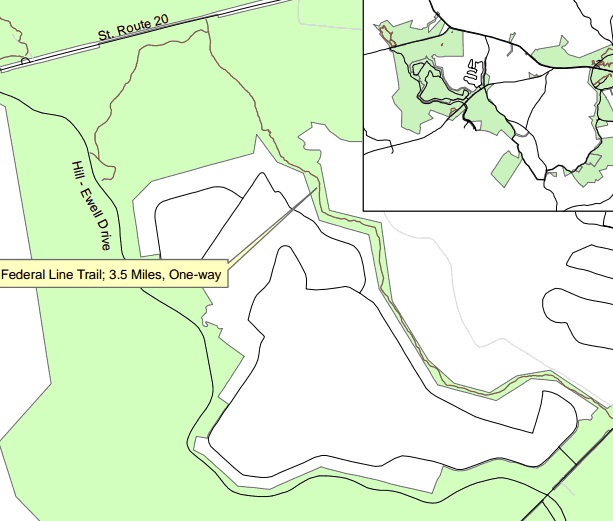
The Federal Line Trail. Source: National Park Service Trail Brochure.
The Wilderness Battlefield features several hiking trails. I decided to start my day by exploring one I've never hiked, the Federal Line Trail, with Gordon Rhea's The Battle of the Wilderness in hand. This 3.6 mile (one way) trail winds along the remnants of the Army of the Potomac's earthworks that stretch between the Orange Turnpike (modern Route 20) and the Orange Plank Road. The trail head is located on Hill - Ewell Drive at a picnic area between stops 3 and 4 of the driving tour.

Confederate earthworks along the start of the start of the trail.
It begins along the main Confederate line of battle and follows a northeasterly direction toward the Orange Turnpike. Through these woods on the afternoon of May 5th the men of Gouvernour K. Warren's Union 5th Corps rolled forward on their way to assault Richard Ewell's men south of the Turnpike, and were repulsed.

Snow-covered earthworks of the Union 5th Corps.
Once the trail nears the turnpike, it turns sharply south and begins to wind along the remnants of entrenchments built by 5th Corps. The veterans built these works along a ridge line west of the Lacy Plantation clearing, where Warren had set up his headquarters. The earthen fortifications are in a pretty decent state of preservation, and white snow still clung to the mounds in places where the sun struggled the penetrate the Wilderness's canopy.

If you look closely you can see the half-moon shape of a lunette fortification here, built to protect an artillery piece supporting Warren's battle line.
Among the remains of the battle here are twelve lunettes dug to protect artillery pieces. Though the pieces were positioned along a fairly prominent ridge line, the dense foliage likely prevented the guns from having any significant effect in the battle.

The descent into the Wilderness Run Valley.
Eventually, the trail descends rapidly into a beautiful ravine cut by Mill Branch, or North Wilderness Run. The trail crosses over the small stream on a recently built foot bridge, ascends a slight ridge, and then descends again into a ravine through which Wilderness Run cuts through. This area seemed to me one of the battlefield's hidden gem locations in terms of obscurity and beauty, and it also gave me a new appreciation for the difficulties faced by the Federal troops during the battle.

Mill Branch.
On the morning of May 5th, the lead elements of Warren's 5th corps broke their camps around Wilderness Tavern. They left the Turnpike near the Lacy Plantation and blindly groped through this area, slogging along a narrow wagon path that cut through the ravines and lowlands toward Parker's Store, several miles to the southwest. Eventually, Warren's lead division emerged from the thickets on the high ground of the Chewning Farm, a clearing that if held, would have prevented the Confederate army's two wings from linking up. With arrival along the Turnpike of Confederate troops, this division later abandoned the strategically important position to link up with the rest of the 5th Corps attacking to the north. On May 6th, the men of the Union 9th Corps also plunged through the ravines of Wilderness Run in a vain effort to exploit the gap that existed between the two Confederate wings.

Modern footbridge over Wilderness Run, supported by stone abutments from an older structure.

Wilderness Run.
South of Wilderness Run, the Federal Line Trail narrows, along with the NPS Boundary lines. The path continues to follow Union earthworks, but the works run essentially through the backyards of housing developments.

Here the park land runs close up to housing development.
I considered pressing forward to complete the entirety of the trail, which round-trip would have been a hike of over seven miles, but I instead chose to return to my car and explore a few other areas of the battlefield.

I made two quick stops at Auto Tour stops 4 & 5, the Higgerson and Chewning Farms, both of which have fairly short paths that get you out of your car. Standing in the clearing on the Chewning Farm, you begin to contemplate the possibilities that may have existed had the 5th Corps maintained its hold on this vital position on May 5th. The commander of the division that took control of this farm was General Samuel W. Crawford. Assisted by Warren's aide Washington Roebling, Crawford argued unsuccessfully against orders to abandon the cleared heights. A more concerted effort to reinforce Crawford and hold the Chewning Farm perhaps could have permanently split the two wings of Lee's army, allowing the Army of the Potomac to deal with each in turn. It is up to debate however, whether such an opportunity truly existed.

Looking north from the Chewning Farm clearing toward the Turnpike.
After a brief lunch, I returned to the battlefield to explore a more commonly visited locale, Saunders Field. Rhea's book in hand I followed the path of the 5th Corps's noon-time assault across this field that met such a slaughter, and then moved on to take in the view from the Confederate lines opposite.

Looking back across Saunders Field from the Confederate perspective. The small white monument in the center-left distance is a memorial honoring the 140th New York.
All in all, I had a pleasant spring day on the battlefield. The Federal Line Trail is definitely something to check out if you want to explore an area of the Wilderness not often seen by general visitors. A word of caution however - the trail does not currently feature interpretive signage, and no NPS walking tour brochure exists as of yet. If you plan to try out this trail, you will need to bring your own maps and resources. Rhea's book is a great option.

Saturday, March 1, 2014

"Fighting Himself Out of His Own Coat"

We tend to make sense of our past political divisions by casting them in the light of our modern day political conflicts. More cynically perhaps, we look to add weight to our modern political persuasions by "claiming" luminaries from the past for our cause. Many of you have probably seen any number of bogus Lincoln quotations that float around on the internet, in which Lincoln seems more intent on staking his position with the modern Tea Party than in commenting on any possible issue that reared its head in Lincoln's own time. "Claiming" Lincoln though is not a partisan issue, both sides do it. I've often heard the argument that the Republican and Democratic parties have simply "switched sides" since Lincoln's time, an overly simplistic notion that fails to take into account the fact that we live in a different world today, with different issues to face.

Our tendency to fight over Lincoln's approbation is not a new tactic. Lincoln himself was guilty of the same sin, and used it to great effect. Take for instance a letter written by Lincoln on April 6th, 1859, declining an invitation to speak in Boston on the occasion of Thomas Jefferson's birthday:
...Bearing in mind that about seventy years ago, two great political parties were first formed in this country, that Thomas Jefferson was the head of one of them, and Boston the head-quarters of the other, it is both curious and interesting that those supposed to descend politically from the party opposed to Jefferson should now be celebrating his birthday in their own original seat of empire, while those claiming political descent from him have nearly ceased to breathe his name everywhere.
Remembering too, that the Jefferson party were formed upon its supposed superior devotion to the personal rights of men, holding the rights of property to be secondary only, and greatly inferior, and then assuming that the so-called democracy of to-day, are the Jefferson, and their opponents, the anti-Jefferson parties, it will be equally interesting to note how completely the two have changed hands as to the principle upon which they were originally supposed to be divided.
The democracy of to-day hold the liberty of one man to be absolutely nothing, when in conflict with another man's right of property. Republicans, on the contrary, are for both the man and the dollar; but in cases of conflict, the man before the dollar.
I remember once being much amused at seeing two partially intoxicated men engage in a fight with their great-coats on, which fight, after a long, and rather harmless contest, ended in each having fought himself out of his own coat, and into that of the other. If the two leading parties of this day are really identical with the two in the days of Jefferson and Adams, they have performed the same feat as the two drunken men.
Having claimed Jefferson for his own party, Lincoln's letter goes on to cloak the Republicans in the mantle of defending the principles of the Declaration of Independence:

But soberly, it is now no child's play to save the principles of Jefferson from total overthrow in this nation.
One would start with great confidence that he could convince any sane child that the simpler propositions of Euclid are true; but, nevertheless, he would fail, utterly, with one who should deny the definitions and axioms. The principles of Jefferson are the definitions and axioms of free society.
And yet they are denied and evaded, with no small show of success.
One dashingly calls them "glittering generalities"; another bluntly calls them "self evident lies"; and still others insidiously argue that they apply only to "superior races."
These expressions, differing in form, are identical in object and effect--the supplanting the principles of free government, and restoring those of classification, caste, and legitimacy. They would delight a convocation of crowned heads, plotting against the people. They are the van-guard--the miners, and sappers--of returning despotism.
We must repulse them, or they will subjugate us.

This is a world of compensations; and he who would be no slave, must consent to have no slave. Those who deny freedom to others, deserve it not for themselves; and, under a just God, can not long retain it.

All honor to Jefferson--to the man who, in the concrete pressure of a struggle for national independence by a single people, had the coolness, forecast, and capacity to introduce into a merely revolutionary document, an abstract truth, applicable to all men and all times, and so to embalm it there, that to-day, and in all coming days, it shall be a rebuke and a stumbling-block to the very harbingers of re-appearing tyranny and oppression.
Your obedient Servant
A. Lincoln--
This 1859 letter previewed the rhetoric Lincoln deployed in the Gettysburg Address, which identified the Declaration of Independence as the founding principle of the country, and called for a new birth of freedom.