Wednesday, January 29, 2014

Albert H. Campbell and the Mapping of Virginia

Recently I've been browsing Civil War maps of Virginia on the Library of Congress's American Memory website. In particular I've spent time studying an 1864 Confederate map of my new home county - Albemarle. The map is a part of the Gilmer Map Collection, named for Jeremy Francis Gilmer, Chief of the Engineer Bureau of the Confederate War Department.

Map of Albemarle: Made under the direction of Maj. A.H. Campbell; Held in the collection of the Virginia Historical Society.

I'll be the first to admit I'm no map expert. I enjoy books that provide high quality, modern maps to help explain combat, but if you asked me to name as many Civil War mapmakers as I could, I probably would stop after Jedediah Hotchkiss. But I was impressed with the detail of the Albemarle County map, and I wanted to find out more about those who made it. I started with the information written directly on the map:
CHIEF ENGINEER'S OFFICE D.N.V.
MAJ. GEN. J.F. GILMER CHIEF ENGINEER.
ALBEMARLE
From surveys and reconnaisances by C.S. Dwight Lt Engrs P.A.
Made under direction of A.H. CAMPBELL Capt. Engrs. in charge of Top. Dept.
I decided to start by tracking down A.H. Campbell. I thought it would be easier than it turned out to be, though in the process I became acquainted with the fascinating story of Confederate efforts to map the seat of war in the east.

Census records indicate that Albert H. Campbell was born in Kanawha County, [West] Virginia sometime around 1826 or 1827. Both Campbell's parents were Yankee-born, Mason Campbell in New Hampshire, and Mary Chaddock Campbell in Massachusetts. The Campbells were living in Kanawha County by 1824, but by the 1850 Census Albert's parents had removed to Washington D.C., where Mason Campbell worked as a clerk.

Campbell graduated from Brown University in 1847, and by 1850 the young man was out west. He is credited as a civil engineer on maps of San Francisco Bay completed in 1850 under the direction of Cadwalader Ringgold. In 1853 and 1854 Campbell accompanied another expedition under Captain A.W. Whipple from Fort Smith, Arkansas, via Albuquerque, to San Pedro, California to survey a potential Pacific Railroad. Then, in 1854 and 1855, Campbell was part of Lieutenant John G. Parke's expedition from San Francisco Bay to Los Angelos, San Diego, and on to El Paso and San Antonio. By 1861, Campbell had quite the impressive resume, and was serving as the superintendent of the Pacific Wagon Roads Office in Washington. Clearly, Campbell had connections in the North and the South, but he sided with the Confederacy. With their pre-war army and War Department connections, Jefferson Davis and Robert E. Lee would have been well aware of Campbell's talents at the start of the Civil War.

Campbell's role in Confederate map making appears to have begun immediately after Robert E. Lee's ascension to command of the Army of Northern Virginia in June of 1862. In the early campaigns of the war, maps used on both sides were woefully inaccurate, many based upon surveys completed in the 1820s at the behest of state legislatures. According to Campbell's own account in Century Magazine in 1888, Lee recognized his deficiency in maps immediately:
One of the first things that engaged General Lee's attention on taking command of the army was the organization of some plan for procuring accurate maps for his own use and that of his commanders. A few days after this event, on the 3d or 4th of June, the writer was sought by Major Walter H. Stevens, Chief Engineer of the army at that time, and Major Jasper S. Whiting, his associate, and was informed that they had been sent from headquarters by General Lee to find a suitable person to take charge of a topographical organization which he was desirous of having formed as soon as possible, and proceed to the field, as he found no maps of consequence on taking command of the army.
Campbell asked to have a previously-made request for an appointment as a captain of engineers expedited, and by June 6th he had his commission and began to organize field parties to survey and map the vicinity of Richmond. Eventually, he oversaw about thirteen parties in all, traveling across the countryside of northern and central Virginia, creating detailed surveys. By the end of the war, Campbell explained, his parties had mapped:
from the western part of Fauquier and Rappahannock counties to Wilmington, North Carolina; from the strategic lines on the eastward Piedmont region of Virginia; and down the valley of Virginia as far as the Potomac River in Jefferson and Berkeley counties; and in southwestern Virginia as far as Smythe county; and nearly all the counties south of James River east of Lynchburg unoccupied by the Federal forces.
The maps were done in incredible detail, and included not only significant geographic features and road networks, but also known fords, passes, and the houses and names of residents. The demand among Lee's officers for these maps was so great that eventually the Topographical Office created a process of utilizing photography to reproduce maps, so as to save time, effort and the cost of reproductions via tracings and lithographic prints.

Map of Louisa County, Virginia; held in the collection of the Virgina Historical Society.

After the war, Campbell became convinced that his maps had been lost to posterity during the fall of Richmond. He wrote that at about 10 p.m. on the night of April 2nd, 1865, "I placed in charge of an engineer officer and draughtsman, upon an archive train bound for Raleigh, North Carolina, a box or two containing all the original maps and other archives of my office." Campbell never learned the fate of these boxes. Luckily for modern researchers, the maps eventually turned up, and can be found in several archives, including the Virginia Historical Society. They were essential tools for Robert E. Lee and his officers during the war. They remain extremely valuable resources today for Civil War and 19th century historians, as well as genealogists.

Let me know if you can point me in the direction of more information on Major Campbell.

Sources Consulted
In addition to those sources linked to above, I also consulted a Library of Congress essay entitled History of Mapping the Civil War, reproduced from Richard W. Stephenson's Civil War Maps: An Annotated List of Maps and Atlases in the Library of Congress.

Personal info on Albert H. Campbell was also located in Through Indian Country to California: John P. Sherburne's Diary of the Whipple Expedition, 1853-1854, edited by Mary McDougall Gordon, and the Report upon United States Geographical surveys west of the one hundreth meridian, prepared by George Montague Wheeler, A.A. Humphreys, and Horatio G. Wright and published by the Government Printing Office in 1889.

Monday, January 20, 2014

Preliminary Schedule Posted for Wilderness & Spotsylvania Sesquicentennial Commemoration

As we move into 2014, I've started looking forward to the next big Sesquicentennial events here in Virginia. May will bring the 150th anniversary of Grant's Overland Campaign. Fredericksburg & Spotsylvania National Military Park has posted a preliminary schedule for their commemorative events. The programs include real-time tours such as a "Sunrise in the Widow Tapp's Field" program on May 6th. Other events will include a vigil for the 22 hours of continuous combat at the Bloody Angle on May 12th, and a Celebration of Freedom to mark the ending of slavery in Virginia and commemorate the first combat between United States Colored Troops and the Army of Northern Virginia.

I've only been able to attend one commemorative event during the Sesquicentennial so far, at Gettysburg. But I plan to attend as many of the events that I can this May.

Sunday, January 5, 2014

Smithsonian Civil War: Inside the National Collection

As the Holidays come to a close, I've spent some time this weekend exploring one of my most welcome gifts - Smithsonian Civil War: Inside the National Collection. Published at the end of 2013 by the Smithsonian Institution and edited by Neil Kagan and Stephen G. Hyslop, this coffee table book highlights 150 Smithsonian artifacts (or artifact sets) related to the Civil War.

The book features nearly four hundred big, glossy pages, filled with high quality photographs and images. An explanatory caption accompanies each artifact, and all 150 entries contain a brief essay, similar to an interpretive label in a museum. The book, as Michelle Delaney writes in its introduction, is "an exhibit between hard covers," designed to trace the full course of a national tragedy - from the growing divide on slavery through Reconstruction and the war's memory - using the best pieces from our national collection.

I'm impressed by the diversity of the material culture on display. This book is far more than a collection of guns, swords, and uniforms. The artifacts tell the story of the Civil War with broad strokes, encompassing the topics of slavery, abolitionism, politics, the armies, the homefront, women at war, technology, and many more. Just like a museum exhibit, the book invites browsing and careful reading alike, and I've done a bit of both.

This blood-stained map powerfully tells the story of Bleeding Kansas. From the Collection of the National Museum of African American History and Culture.
So far I've sat down and carefully read through about a quarter of the book, and already I've come across several powerful artifacts that could serve as centerpieces in any exhibit exploring the Civil War.  Two powerful pieces stand out. First, a blood-stained map of the Mississippi River Basin from the collection of the National Museum of African American History and Culture. The map was found on the body of David Starr Hoyt, an abolitionist murdered by pro-slavery forces outside of Lawrence, Kansas in 1856.


Abraham Lincoln's Pocket Watch. From the Smithsonian Museum of American History, Kenneth E. Behring Center.
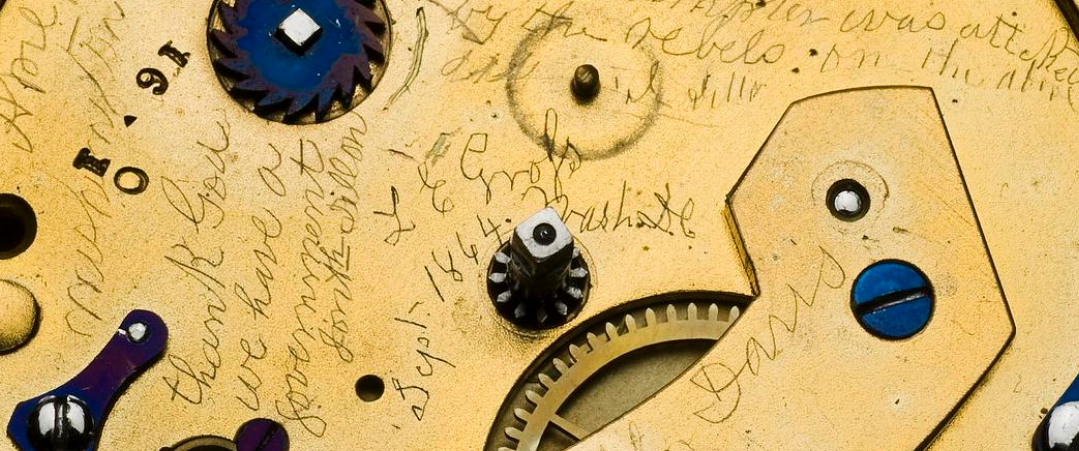
The second artifact that really spoke to me was Abraham Lincoln's gold pocket watch. Lincoln purchased the watch in the late 1850s, and sent his watch to M.W. Galt & Company for repairs when he arrived in Washington in 1861. His watch changed forever when news of the bombardment of Fort Sumter arrived in the city on April 13, 1861. Jonathan Dillon, the watchmaker repairing the watch at that time, decided on that day to inscribe a message on the inner workings of the watch with a sharp metal instrument. He recorded the news of Fort Sumter, set down his name and the date, and wrote "thank God we have a government." Through the years, other watchmakers who had the opportunity to view the inner workings of Mr. Lincoln's watch also added their own inscriptions, including one who wrote "Jeff Davis." Lincoln probably never knew of the secret messages inside his pocket watch. Incredibly, the story of the messages inside the watch was passed down through Dillon's family over the years. Staff at the National Museum of American History never had any cause to uncover the inner workings of the watch, and knew nothing of Dillon's story. In 2009, descendents of Dillon contacted the Smithsonian about the watch, and on March 10, 2009, the inscriptions were revealed to Dillon's family, reporters, and museum staff.

These are just two of an array of incredible pieces from the National Collection highlighted. If you are like me, and you appreciate the power objects have to convey meaningful stories, you will enjoy this book.

Thursday, January 2, 2014

2013: My Year in Books

As we move into the New Year, I've been looking back on the Civil War books I had a chance to pick up in 2013. My reading list this year included a good mix of political, social and military history. It also featured some of the newest titles from 2012 and 2013, older titles significant to Civil War historiography, and a few primary sources.

Bruce Levine was a repeat author on the list this year. I started the year off with his 2006 book, Confederate Emancipation, and later in the year I picked up his newest work, The Fall of the House of Dixie. In March, I enjoyed Walter Stahr's political biography, Seward: Lincoln's Indispensable Man. Meanwhile, in the way of primary sources, I finally got around to a few essential works that have been on my list for a long time - Gardner's Photographic Sketch Book of the Civil War, All for the Union: The Civil War Diaries and Letters of Elisha Hunt Rhode, and Theodore Lyman's With Grant & Meade: From the Wilderness to Appomattox.

2013 was also a year of campaign histories for me. In addition to rereading a significant portion of my favorite series, Gordon Rhea's books on the Overland Campaign, I went west to read Peter Cozzens' This Terrible Sound: The Battle of Chickamauga. As the 150th anniversary of Gettysburg approached, I made my way through Allen Guelzo's new work, The Last Invasion. But my favorite campaign study, and my favorite read this year overall, was Scott Hartwig's 2012 publication To Antietam Creek. Here's hoping that Mr. Hartwig's retirement will help to speed along volume two.

A lot of intriguing titles came out in 2013 that I could not get to, especially as I devoted the last three months of the year to a crash course in the history of the Early Republic and Thomas Jefferson. Among the 2013 releases that made it to my "to-read" list: Richmond Must Fall by Hampton Newsome, Scott Patchan's The Last Battle of Winchester, and (a bit out of Civil War territory) The Internal Enemy: Slavery and the War in Virginia, 1773-1832 by Alan Taylor.

What were your favorite reads of 2013?

Wednesday, December 25, 2013

Merry Christmas!

A Christmas view of the Wren Building and Lord Botetourt taken on a recent trip to Williamsburg.

Merry Christmas everyone! I hope you all have a wonderful holiday and a Happy New Year. The blog is still in hiatus at present, but I'm slowly moving back into research mode, and hope to have some new posts up at Battlefield Back Stories in the new year!

Friday, December 6, 2013

Honoring Mandela

Unrelated to the Civil War of course, but NPR has posted this archived piece on their website today - a five part series produced in 2004. It's definitely worth a listen.

Sunday, December 1, 2013

A Hike at Spotsylvania

On Friday Emily and I decided to skip the craziness of holiday shopping. Instead, we took a drive over to the Fredericksburg area to take advantage of the beautiful, if chilly, weather. We wanted to avoid the shopping traffic on Route 3 as much as possible, so we stuck to the 1864 campaign. After a very brief driving tour of the Wilderness, with stops at Saunders Field, the Widow Tapp clearing, and the Brock Road intersection, we followed the Army of the Potomac's march down the Brock Road and left our car at the Spotsylvania Exhibit shelter.

Armed with a great set of maps from Blue & Gray magazine, we set off on the Spotsylvania History Trail. For me, hiking is the only way to tour a battlefield properly, and Fredericksburg & Spotsylvania National Military Park has established some great trails at all of its battle sites. The trail at Spotsylvania consists of several connected loops, allowing a battlefield tourist the option of choosing a short hike, sampling a portion of the trail, or setting out to hike the entire seven miles. We chose to spend several hours and hike most of the trail, which begins and ends at the Exhibit shelter.

Setting out to follow in the footsteps of the 5th Corps across the open fields of the Spindle Farm.

We first traversed ground rarely seen by the average visitor touring the field in a car - Laurel Hill. The term "hill" is actually a misnomer, the terrain is undulating here. In these open fields stood the farmhouse of Sarah Spindle. On May 8th, as Confederate cavalry fell back down the Brock Road, disputing the advance of G.K. Warren's 5th Corps, Confederate infantry arrived in the nick of time to take position on a slight rise of ground behind hastily-made barricades. Warren launched several uncoordinated assaults against the Confederate position on Laurel Hill, trying to break through and into Spotsylvania Courthouse, but each failed. By the end of the day, the Army of Northern Virginia strengthened its position firmly astride the Army of the Potomac's route of advance. On May 10th and again on May 12th, the federals attempted to take Laurel Hill by frontal assault. However, the open fields and the convex shape of the Confederate works in this location subjected Union troops to a terrible crossfire during each attempt, and they met bloody repulses. Hiking across this terrain gives you a good sense of the disadvantages Union soldiers faced. You can also see a small monument to the Maryland Brigade, placed at the point of the furthest advance made by Union forces on May 8th.

Toward the Confederate position at Laurel Hill.

The Laurel Hill loop of the trail returned us to the Exhibit Shelter, and we set out on part two of our hike, which follows along the remnants of earthworks that belonged to the Army of the Potomac's 6th Corps until it reaches Upton's Road. On the evening of May 10th, Colonel Emory Upton led 5,000 hand-picked federal troops in a lightning-fast charge upon Doles' Salient, a mere 200 yards distant. The federals guided upon this narrow farm lane. Upton utilized a compact formation and ordered his men not to fire until they had reached the Confederate works. He broke the Confederate line at the salient, but receiving no support, his men were forced back eventually.

Upton's Road
Looking toward Doles' Salient.
Having followed the route of Upton's assault, the hiking trail then traverses the signature feature of the Confederate defensive line at Spotsylvania, the "Mule Shoe." Several monuments line this portion of the trail, as do multiple interpretive markers that tell the story of the famed assault on May 12th, 1864, and the fighting at the Bloody Angle. At 4 a.m. on that morning, some 20,000 federal soldiers under Winfield Scott Hancock overwhelmed Confederate forces at the Mule Shoe. Robert E. Lee fed Confederate reinforcements into the fight, hoping to buy time to allow his engineers to build a new line at the base of the Mule Shoe. For twenty hours the battle raged at close quarters, often hand-to-hand. The intensity and duration of the fighting that took place here has no other parallel during the war.

The Mule Shoe.
A side excursion of the hiking trail leads out to the Landram House ruins, which Hancock's 20,000 men swarmed past on their way to the Mule Shoe. We chose instead to continue following along the Confederate earthworks to the East Angle. From here the trail then visits two other homes unfortunately located in the path of war, the McCoull House site and the Harrison House. Both of these farms were located in the rear of the Confederate Mule Shoe position. They became the staging areas for the Confederate counterattacks that swept into the maelstrom at the Mule Shoe.

From the Harrison House, the hiking trail weaves its way through a wooded landscape along what became Lee's final line at Spotsylvania, the works constructed during the day on May 12th while the fighting raged at the Mule Shoe. Early on the morning of May 13th, the Confederates pulled back from the Mule Shoe and took position here. I had never visited this area of the battlefield before, and these earthworks are in an incredible state of preservation. The were among the strongest field fortifications that had been constructed up to that point in the war. The Army of the Potomac found this out several days later in its ill-fated assault on May 18th.

We hiked along these amazing earthworks, still imposing features on the landscape some 150 years later, until we reached the Brock Road, where we turned north and looped back to the Exhibit Shelter to complete our hike. In all, we logged somewhere close to five miles. It was a great way to spend Black Friday. If you enjoy hiking on Civil War battlefields, put the Spotsylvania History Trail on your list.