Showing posts with label Material Culture Thursday. Show all posts

Sunday, January 5, 2014

Smithsonian Civil War: Inside the National Collection

As the Holidays come to a close, I've spent some time this weekend exploring one of my most welcome gifts - Smithsonian Civil War: Inside the National Collection. Published at the end of 2013 by the Smithsonian Institution and edited by Neil Kagan and Stephen G. Hyslop, this coffee table book highlights 150 Smithsonian artifacts (or artifact sets) related to the Civil War.

The book features nearly four hundred big, glossy pages, filled with high quality photographs and images. An explanatory caption accompanies each artifact, and all 150 entries contain a brief essay, similar to an interpretive label in a museum. The book, as Michelle Delaney writes in its introduction, is "an exhibit between hard covers," designed to trace the full course of a national tragedy - from the growing divide on slavery through Reconstruction and the war's memory - using the best pieces from our national collection.

I'm impressed by the diversity of the material culture on display. This book is far more than a collection of guns, swords, and uniforms. The artifacts tell the story of the Civil War with broad strokes, encompassing the topics of slavery, abolitionism, politics, the armies, the homefront, women at war, technology, and many more. Just like a museum exhibit, the book invites browsing and careful reading alike, and I've done a bit of both.

This blood-stained map powerfully tells the story of Bleeding Kansas. From the Collection of the National Museum of African American History and Culture.
So far I've sat down and carefully read through about a quarter of the book, and already I've come across several powerful artifacts that could serve as centerpieces in any exhibit exploring the Civil War.  Two powerful pieces stand out. First, a blood-stained map of the Mississippi River Basin from the collection of the National Museum of African American History and Culture. The map was found on the body of David Starr Hoyt, an abolitionist murdered by pro-slavery forces outside of Lawrence, Kansas in 1856.


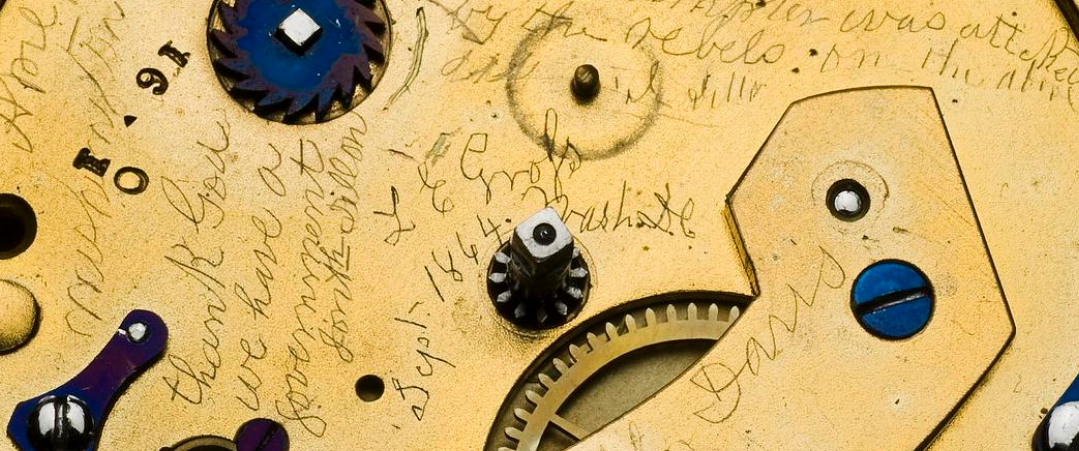
Abraham Lincoln's Pocket Watch. From the Smithsonian Museum of American History, Kenneth E. Behring Center.
The second artifact that really spoke to me was Abraham Lincoln's gold pocket watch. Lincoln purchased the watch in the late 1850s, and sent his watch to M.W. Galt & Company for repairs when he arrived in Washington in 1861. His watch changed forever when news of the bombardment of Fort Sumter arrived in the city on April 13, 1861. Jonathan Dillon, the watchmaker repairing the watch at that time, decided on that day to inscribe a message on the inner workings of the watch with a sharp metal instrument. He recorded the news of Fort Sumter, set down his name and the date, and wrote "thank God we have a government." Through the years, other watchmakers who had the opportunity to view the inner workings of Mr. Lincoln's watch also added their own inscriptions, including one who wrote "Jeff Davis." Lincoln probably never knew of the secret messages inside his pocket watch. Incredibly, the story of the messages inside the watch was passed down through Dillon's family over the years. Staff at the National Museum of American History never had any cause to uncover the inner workings of the watch, and knew nothing of Dillon's story. In 2009, descendents of Dillon contacted the Smithsonian about the watch, and on March 10, 2009, the inscriptions were revealed to Dillon's family, reporters, and museum staff.

These are just two of an array of incredible pieces from the National Collection highlighted. If you are like me, and you appreciate the power objects have to convey meaningful stories, you will enjoy this book.

Thursday, March 21, 2013

Incorporating the Commemorative Landscape: The 121st PA

Back in January I started a weekly material culture series. I was going strong for about 5 weeks before I faltered a bit. This week, Material Culture Thursday returns with a look at the monument(s) of the 121st Pennsylvania.

12st PA Monument on Reynolds Avenue.
Photo by Jenn Goellnitz. Creative Commons Licensing.
During the Future of Civil War history conference, I attended an excellent field experience entitled Incorporating the Commemorative Landscape into Civil War Interpretation. We boarded a bus on a cold and rainy Saturday morning and headed out to the battlefield with Sue Boardman, Thomas Desjardin, and Thomas Brown. For an hour and a half our group analyzed the interpretive potential, and the dangerous pitfalls of Gettysburg's monuments. Along the way we considered a number of questions. How for example, can public historians help visitors approach Civil War battlefields as commemorative, not historical, landscapes? And how can we assist those visitors in learning to read a monument?

The monuments are part of what makes Gettysburg such a compelling interpretive space. These huge hunks of carved stone, can tell us so much, but only if we approach them carefully. Arm a visitor with a tiny bit of knowledge, set them loose on the battlefield, and the monuments can confuse and misinform in a hurry. Take Culp's Hill, for example. Wind your way along the battlefield avenues, glimpsing the vast array of stone sculptures representing units from the 6th and 12th Corps, and you would never guess that on the evening of July 2nd, one lonely Union brigade fought a desperate fight in the trenches against a much larger foe.

Battlefield monuments often tell us more about the time that they were erected than they tell us about the battle. Confederate state monuments erected in the 1960s, for example, tell us more about the Civil Rights movement - and reactions to it - than they do about the soldiers who fought at Gettysburg. And yet, equipped with a good sense of the different eras of commemoration and a bit of background history on the monuments themselves, a visitor can learn a great deal. Many of the monuments at Gettysburg - particularly Union monuments - are primary sources placed on the battlefield by veterans. As such, they reveal exactly what those veterans wanted us to learn about their experience.

A great example  is the monument of the 121st Pennsylvania on Reynolds Avenue. The veterans of the 121st placed this memorial in the general area that they fought on July 1st on the extreme left flank of the First Corps line. This was not the first monument these veterans placed on this location. In 1886, they dedicated an eleven-foot-high granite shaft on the location, paid for by funds they raised on their own. The following year, the state of Pennsylvania awarded every regiment that fought at Gettysburg $1500 to erect a monument on the field. And so, in 1888, the 121st survivors had the original monument moved to a secondary location on Hancock Avenue, and replaced it with the more impressive one we see on Reynolds Avenue today.

Several features of the Reynolds Avenue monument stand out. The die of the monument is designed to represent a large knapsack with blanket roll on top. The monument also contains bronze representations of the accoutrements of a soldier: a kepi, sword, musket, cartridge box and bayonet. The state seal and a circle (the symbol of the First Corps) show the regiment's affiliations. Finally, two interesting details set the monument apart from some of the more basic memorials on the field: a depiction of a bursting shell in the upper left corner, and an American flag draped over the upper right corner. Both of these details tell us a part of the 121st's experience at Gettysburg.

During the afternoon of July 1st, the men suffered severely from artillery fire, particularly rounds fired from Confederate batteries on Oak Hill. With little cover in the fields north of the Fairfield Road, and enfiladed by those Oak Hill batteries, the regiment shifted positions multiple times in an effort to gain some measure of protection. In depicting an exploding shell on the monument, the veterans told future generations that the awful experience of shells exploding in their midst remained one of their primary recollections of their experience 25 years later.

Later that afternoon, The 121st was outflanked and driven back in confusion, first to the Lutheran Seminary, and eventually through town after a brief last-ditch stand. Writing his report on the regiment's engagement while still on the battlefield the following day, Major Alexander Biddle highlighted the conduct of his Color-Sergeant:
I beg particularly to call attention to the meritorious conduct of Sergeant [William] Hardy, color-bearer, who carried off the regimental colors, the staff shot to pieces in his hands.
In his book, Gettysburg: Stories of Men and Monuments as Told by Battlefield Guides, LBG Fred Hawthorne relates that Sergeant Hardy stopped to pick up a roofing shingle while retreating through town on July 1st. He used the shingle to splice together the shattered pieces of the flag pole. For the rest of the war, this spliced together pole reminded the men of the regiment of their horrific experience at Gettysburg, where the regiment suffered an astounding 70% casualty rate. 

Today, the image of the flag of the regiment, draped over the monument without a staff, along with the exploding shell, show us what the veterans of the 121st remembered about their experience at Gettysburg. Their monument stands as a testament to these stories, reflecting what they wanted us to learn about when we visited the site of their engagement. Speaking at the dedication of the monument on Pennsylvania Day in 1889, Captain Joseph Rosengarten pronounced: 
Leaving to others the general record and history of the war for the Union, let us strive to preserve every name and every deed that forms part of our record as a regiment, content in this, as we were in war, to do our duty without fear or favor.... The record of the One hundred and twenty-first is perpetuated on the memorial which we dedicate to-day, and it is one of which the survivors have just reason to be honestly proud.
So how can we encourage visitors to approach the Gettysburg battlefield as a commemorative landscape? First, we must get them to understand that the monuments have a history of their own. To accurately understand the meaning of a monument, you must know who placed it, why they placed it, and when they placed it. In understanding the motivations of the group that placed a monument, and the period of history during which it was placed, you can begin to unlock a monument's meaning and historical context. Just like any other source, monuments can tell us a great deal if we can place them within the proper historical framework.

Thursday, February 14, 2013

The Army of the Potomac's French Poet-Warrior

For this week's Material Culture Thursday I highlight one of my favorite artifacts from the New York State Museum's current Civil War exhibit - "An Irrepressible Conflict": The Empire State and the Civil War. I reviewed the exhibit in a post last week. Today's item - an officer's commission belonging to Philip Regis de Trobriand, one of my favorite personalities who fought in the Battle of Gettysburg.


This commission appointed de Trobriand a Colonel of New York State Militia, with rank from July 20th, 1861. The document itself was dated August 3rd, 1861, and was signed by the Governor of New York, Edwin Morgan, and Adjutant General of New York State Militia Duncan Campbell.

I have always found de Trobriand one of the more fascinating characters in the war. Born on June 4, 1816 at the Chateau des Rochettes near Tours, France, he was the son of a baron and general in the French army. As a young man Regis - he dropped his first name when Louis Philippe took the crown - studied at the Universities of Tours and Poitiers, and aimed to become a lawyer. He was also known to have participated in duels.

De Trobriand dabbled in poetry as well, and in 1840 published a novel entitled Les Gentilshommes de l'Ouest. The following year, the aristocrat traveled to America for the first time, where he met his future wife, a New York heiress named Mary Mason Jones. The young couple traveled through Europe after their marriage, lived for a time in Venice, but eventually returned and settled in New York in 1847. In New York the Baron focused on his literary work, becoming a regular contributor to the French newspaper, Le Courrier des Etats Unis, as well as other French language publications. 

In July of 1861, de Trobriand became a citizen of the United States and received permission from the War Department to recruit a regiment for service. That regiment, the 55th New York, was known as the Lafayette Guard. Recruited in New York City, most of the men in the regiment were French. De Trobriand led the regiment on the Peninsula and at Fredericksburg. After that battle the depleted 55th merged with the 38th New York, which de Trobriand led at Chacellorsville. Before Gettysburg, the Third Corps underwent a reorganization and de Trobriand received command of the Third Brigade of the First Division.
 
De Trobriand might have been an eccentric French aristocrat with literary flare, but by July 2, 1863 he had also become a battle-hardened combat commander in the Army of the Potomac. When Daniel Sickles took up his forward line on that day, de Trobriand found himself with a difficult if not impossible assignment. Maj. Gen. David Birney's First Division was tasked with covering a huge amount of ground, stretching from the Peach Orchard salient, manned by the division's First Brigade, to Devil's Den, covered by the Second Brigade. De Trobriand's five regiments would have to cover the vast space between.

The ground assigned to de Trobriand was rocky and wooded. The west branch of Plum run ran across his front and beyond that the cleared fields of the Rose Farm stretched to the Emmitsburg Road. Behind de Trobriand the six Napoleons of Battery D, First New York Light unlimbered in the Wheatfield. With his 3rd Michigan out on the skirmish line, de Trobriand positioned his other four regiments as best he could on the Stony Hill. He would not be able to stretch his line to connect with the flanks of either the First or Second Brigades. If the attack came to his front, he would have to depend on covering his own flanks, or hope for reinforcements.

When the Confederate attack began against Devil's Den that afternoon, de Trobriand's forces would be further depleted. He would lose the the 40th New York (the Mozart Regiment), ordered away to reinforce the Second Brigade's left flank at Devils Den. He would also reposition the 17th Maine further to the left, to occupy a stonewall on the southern edge of the Wheatfield and assist the right of the Second Brigade's line.

Regis de Trobriand, photo from Civil War glass negative collection at the Library of Congress.
With the 17th along the stonewall, and the 5th Michigan and 110th Pennsylvania in line of battle along the branch of Plum Run, de Trobriand's men went into action first against Anderson's Georgia brigade, and later against Joseph Kershaw's South Carolinians . His three regiments would receive reinforcements in the form of two regiments from another 3rd Corps brigade, and two brigades from Barnes' 5th Corps division. But these reinforcements would soon fall back in the face of the Confederate attack, forcing de Trobriand and his men to do the same.

Facing two Confederate brigades, de Trobriand and his men could not hold the Confederates off for long. Yet they did delay the Confederate advance long enough for more federal reinforcements to reach the scene and counterattack. The assaults and counter assaults in the Wheatfield would continue, though the Third Brigade's involvement was over. The regiments that fought in the Wheatfield zone under de Trobriand's command lost 340 out of a total strength of 955 - roughly 36% of their strength.

After Gettysburg, de Trobriand briefly left the army after the senate did not confirm his promotion to Brigadier General in the fall of 1863, despite the recommendations of his superior officers. In January of 1864, the promotion came through and de Trobriand was assigned to command the defenses of New York. He would eventually find his way back into the Army of the Potomac, where he commanded the 1st Brigade, 3rd Division, 2nd Corps - troops that belonged to the old 3rd Corps. He remained in this position until the end of the war.

After the war de Trobriand was brevetted a Major General for meritorious conduct and mustered out of the volunteer service, but his military career did not end. After a leave of absence to write memoirs of his wartime service, de Trobriand returned to the regular army as a Colonel. He served at various posts until 1879.

De Trobriand's commission in the State Museum's exhibit is presented in a section discussing New York's foreign-born population and the importance of its involvement in the Civil War. This French Baron, poet and novelist certainly ranks as one of the more fascinating immigrants that served in the Army of the Potomac during the war.

Thursday, January 31, 2013

Pennsylvania Day

Pennsylvania Day program from the archives of the National Museum of American History.

The morning dawned with a faint hope that the nor'easter had passed. The pelting rains of the previous day had already made many of the roads a muddy quagmire. Tthe dark gray clouds and chill winds looked ominous, and yet the mounted aides dashing about seemed to indicate that the march would come off as planned. Regiments had begun to organize themselves when, sometime between 10 and 11 a.m., the winds picked up and the rain began to fall. General David McMurtrie Gregg had seen enough, and issued the necessary orders. The parade of veterans was off.

The weather had not fully cooperated with the Pennsylvanians on their day of days, and even before the parade's cancellation the railroad depots faced a crush of veterans and spectators. As each train sped away packed to full capacity, those remaining in town sought whatever shelter they could to get in out of the downpour. The long anticipated Grand Parade being off, the Gettysburg Compiler noted, "the one desire on all sides was to get away, and the formal exercises...attracted a comparatively small audience." It was a quiet end to what had been several action packed days in Gettysburg, Pennsylvania.

The crowds had begun to swell earlier in the week. A dispatch sent to the Bradford Era on Tuesday, September 10th observed: "All day long veterans from the eastern and central portions of the State have been marching from the depots to camps." It estimated that the crowd might reach 50,000 by Thursday. Reporting after the festivities had concluded, the Star and Sentinel gave an estimate of 20-40,000, while The Compiler settled on 30,000.

They had all come to celebrate Pennsylvania Day. Among the throng were roughly 10,000 veterans, brought to Gettysburg via free transportation provided by the state of Pennsylvania. The rest consisted of family members, dignitaries, and general spectators who wanted in on the big event. "There was scarcely a house in town," The Compiler reported, "that did not in some way contribute to the entertainment of the visitors, and many of them got quarters in farm houses within a radius of several miles around the place."

Wednesday, September 11 - Veterans' Day - featured the dedication of 46 regimental monuments all over the field. From morning to evening, the town buzzed with the activity of regimental associations moving through town out to the various dedications, even when the driving rainstorm set in that afternoon. That evening was devoted to eating, drinking, music, and story telling. The Compiler claimed that the supply of provisions at the eateries in town held out. "The supply of wet goods was also equal to the occasion," it added, "the malt product being in general favor." Despite the merry-making, law enforcement managed to maintain good order, and the Star & Sentinel reported that no arrests were made, "except for drunkenness."

Thursday, despite the rush to get out of town, the formal ceremony slated for 1:30 went off, though the venue moved from the National Cemetery to the rink, a long, low building in town frequently used for balls and other festivities. The venue could hold nearly 3,000, but many estimated the crowd at less than half of that. Even the presiding officer, Colonel George Meade Jr., cancelled due to illness. The program featured Governor James A Beaver, an address on the first day of the battle delivered by Brevet Capt. Joseph Rosengarten (aide-de-camp of Maj. Gen. Reynolds), and an address on the final two days of the battle given by Brevet Brig. Gen. Henry Bingham (Major on Maj. Gen. Hancock's staff). The Pennsylvania monuments were officially transferred to the Battlefield Memorial Association, and Edward McPherson accepted them on the Association's behalf.

To many who participated, these couple of days in Gettysburg seemed like a last great gathering on the battlefield. As the Star & Sentinel explained it:
It was a common remark among the veterans that never again would there be upon the field of Gettysburg so many of the men who actually fought here; every year, every month, even every week, sees their ranks thinned by death, and the time is not many years distant when the last of them shall have answered the final roll-call. For this reason, there was a peculiar fervor in all the exercises and a lingering reluctance to part, perhaps forever.
It also seemed like one last opportunity to mark in stone the importance of this place. "Gettysburg was never so crowded with people," The Star & Sentinel proclaimed, "and we trust it never will be so again."


While the reports seemed to indicate a passing of an era - the case was overstated. In another column on the same page that it lamented the fading of the veterans, the Star & Sentinel noted that the 48th, 140th, and 150th New York had arrived in town to dedicate monuments. It went on to remind its readers that the Maine Monument Commission would arrive in early October to dedicate its monuments on the field.

Great gatherings of veterans would continue to come, through the 1890s, and into 20th century. For New York Day, for the dedication of the Pennsylvania Memorial, and for the 50th anniversary. And even when the veterans did fade away, the visitors would not. Just as Lincoln underestimated our ability to mark the importance of his words at the dedication of the National Cemetery, the Star & Sentinel underestimated the power of this memorial field that the veterans had created. Despite the paper's prediction that Pennsylvania Day in 1889 would be Gettysburg's biggest and last hurrah, today the borough of Gettysburg draws nearly 20,000 alone for bike week, and many thousands more for the annual battle anniversary. And in this year, the 150th since the battle of Gettysburg, it is estimated that nearly 4 million people will flock to the fields outside of town.

Today, this program for Pennsylvania Day tells us the story of one of the great veteran reunions at Gettysburg, where 46 monuments were dedicated, and the weather just wouldn't cooperate. More than that, it shows us the importance that those Pennsylvania veterans, and their comrades from other states, placed on the hallowed ground of Gettysburg, and how they wanted their youthful deeds to stand here for all time, etched in stone. In their efforts to memorialize their service, they created a sacred site unequaled in the United States.

Thursday, January 24, 2013

James H. Stetson's New Testament

The New Testament owned by James H. Stetson, killed at Gettysburg.
Image source: americanhistory.si.edu.
One of the things I love about historical artifacts is that there is often so much more than meets the eye. For most artifacts on exhibit in a museum, the curator only has a small amount of space to explain the historical significance. For the sake of brevity, the story you get, while interesting, is often only the tip of the iceberg.

If you take the time to dig a little deeper, a whole story awaits discovery. Recently I experienced this phenomenon when browsing through the online collections database of the National Museum of American History. I came across the following entry: New Testament owned by James H. Stetson, who was killed at the battle of Gettysburg. Aside from giving an overview of the battle, the entry for this artifact did not tell me much about James H. Stetson, other than that he was killed at the battle. The tip of the iceberg.

I wanted to know more: who was James Stetson and where was he from, how old was he, to what regiment did he belong, and where did he fight at Gettysburg. I decided to dig a bit deeper on my own. I know the Smithsonian probably has a file with a great deal of information about the artifact, including the artifact's provenance, but these sources are not readily available. Despite this, I managed to use the wonderful array of digital sources now available on the web to put together a pretty good picture of our soldier's story. Through the National Park Service's Soldiers and Sailors system I located a few James Stetson's - but I soon narrowed it down to the one I sought.

James Henry Stetson was born on July 12, 1842 in Medford, Massachusetts. His father, John, was a shipwright. The 1860 Census reveals that the eighteen-year-old worked in Medford as a clerk. On July 16, 1861 James enlisted in Company C of the 13th Massachusetts. Nearly two years later, on the morning of July 1st, 1863, the 13th marched toward Gettysburg as part of the 1st brigade, 2nd division, 1st Corps of the Army of the Potomac.

We can't know exactly what James experienced at Gettysburg, but we can get a sense by other accounts left to us. Private Charles E. Davis Jr. of Company B left us one of these accounts in his 1894 regimental history, Three Years in the Army: The 13th Massachusetts from July 16, 1861 to August 1, 1864. Davis recalled that the 13th arrived at the Lutheran Seminary sometime around 11 a.m. and soon proceeded to throw up breastworks along Seminary Ridge on the orders of General Doubleday. His account continued:
While we were on Seminary Ridge, spent cannon-balls could occasionally be seen rolling slowly along the earth from the battle-ground to the north of us. Such a sight was common enough during battles, as every soldier knows, and once in a while a man was seen who was foolish enough to try stopping one. While we were busy with our earthworks, such an incident happened close to us. One of our officers saw a soldier of a Wisconsin regiment with great glee, boldly put out his heel to stop a ball that was rolling toward him, supposing it to be the easiest thing in the world to do. Those who saw his purpose yelled with all their might; but it was too late, for when their remonstrances reached his ear his leg was off. The poor fellow cried like a child to think he had lost his leg in such a manner, when, as he said, he would gladly have lost it in action.
Soon the brigade, commanded by Brig. Gen. Gabriel Paul, had orders to leave the Seminary and move north to confront elements of Ewell's Corps on Oak Ridge. Davis continued:
We filed round the front of the building, then east a short distance to a bed of an unfinished railroad, then north and north-west to an oak grove near the Mummasburg road, where we were faced, at first, to the north-west in line of battle. As we came into position we saw the rebel line advancing by brigades formed en masse.
These Confederate units belonged to the brigades of Colonel Edward A. O'Neal and Brig. Gen. Stephen Dodson Ramseur. Davis remembered:
Firing as rapidly as possible, we drove the enemy back, while we slowly advanced toward the Mummasburg road. Each time the enemy advanced we drove him back, while up and down the line officers were encouraging the men.
13th Massachusetts monument at Gettysburg. The
monument features Color Sergeant Roland G. Morris,
who also fell in the fighting on July 1st, 1863.
Photo by Michael Noirot. Creative Commons Licensing.
Writing a month after the battle, Lieutenant Colonel N. Walter Batchelder reported that the regiment occupied the extreme right flank of Paul's brigade, and that its Colonel, Samuel Haven Leonard, was wounded early in the fighting. Even  so, Batchelder believed that the command had maintained a steady fire against the enemy for upward of an hour. Soon a Confederate regiment approached the Mummasburg Road and took shelter behind its banks, causing serious annoyance to the 13th. Batchelder ordered a bayonet charge on the road and captured over 130 Confederates.

After a long fight along the Mummasburg Road, the 13th eventually found its supply of ammunition dwindling and both flanks of the army beginning to retreat back toward the town. The 13th would have to do the same. Private Davis recalled the retreat:
We saw the end was near and fell back towards the hill, each man for himself, it being impracticable to do otherwise without losing still more men. The order was given to rally on Cemetery Hill. While some of the boys fell back along the railroad cut, others went directly through town to the hill. Those who went through the town were obliged to run the gauntlet of the side streets, already filled with men of Ewell's corps, who were endeavoring, with artillery and musketry, to prevent our escaping. We saw at once that we had stayed at the front a little too long for our safety. Some of us were to be gobbled and sent to rot in rebel prisons. Over fences, into yards, through gates, anywhere an opening appeared, we rushed with all our speed to escape capture. The streets swarmed with the enemy, who kept up an incessant firing, and yelling, "Come in here, you Yankee ------!" Still we kept on, hoping to find a chance of escape somewhere.
Of the 284 men that went into battle, only 99 mustered with the regiment when it rallied that evening on Cemetery Hill. The regiment had lost 7 killed, 77 wounded, and 101 missing. One of those killed in action that afternoon was James H. Stetson.

Today, Stetson's New Testament resides in the National Museum of American History. I do not know how this artifact came to the museum's possession, or whether Stetson himself carried the bible with him during his service as a soldier. Yet the bible helps to preserve the story of a young 21 year-old soldier, whose patriotism called him to serve his country, and who gave his last full measure of devotion to the cause on July 1st, 1863.

Thursday, January 17, 2013

The Sword of McClellan

Sword and scabbard presented to Major General George
McClellan by the citizens of Boston on Feburary 5,
1863. National Museum of American History, Kenneth E.
Behring Center. Image Source: americanhistory.si.edu.
We tend to view swords as military objects, and with good reason. Swords have a tremendous amount of symbolic importance to military affairs. Outside of cavalry sabers of course, swords did not constitute a weapon of choice during the Civil War, but they served as a physical representation of leadership and respect. Swords were wielded by officers in battle to direct troop movements. Often, soldiers and citizens collected funds to commission special swords and present them to officers as a sign of respect and gratitude. This sword presented to Major General George B. McClellan, which resides in the collection of the National Museum of American History, can also be seen as an electioneering artifact.

The entry for this sword in the Smithsonian's digital collections page explains that citizens of Boston, Massachusetts presented it to McClellan on February 5, 1863. The inscription on the scabbard reads:
TO / Major General George B. McClellan. / from many / Citizens of / BOSTON / February / 5th 1863. / Pro rege saepe, pro patria semper.
The Latin translates: "For king often, for country always." I found some things about this sword presentation worth further inquiry - Lincoln of course had sacked McClellan as commander of the Army of the Potomac several months before this presentation, and Boston seemed to me an odd location for a sword presentation to a well known Democrat. And so, I went to the newspapers.

I found a full description of the sword presentation in the February 13, 1863 edition of Dawson's Daily Times and Union, a Fort Wayne, Indiana newspaper:
GENERAL McCLELLAN IN BOSTON.
Presentation to Him of a Splendid Sword.
(From the Boston Post, Feb. 6)
Not the least interesting event of yesterday--and we are not sure that it was not the most so--was the presentation at 7 o'clock, at the Tremont House, of a sword, belt and sash, to Gen. McCellan. This ceremony took place in the ladies' parlor, and in the presence of some fifty citizens. The testimonial was the offering of citizens from dollar subscriptions, and, as its cost was about $900, the number of donors, it is easy to see, was very great, and the honor of the gift all the more emphatic. It was presented through the hands of a committee of liberal-minded and appreciative citizens. Hon. Geo. Lunt, was delegated to transmit the testimonial. In doing so he said the occasion was not intended to be formal, and that, therefore, he should proceed at once to read a letter which had been prepared. The following is the letter as read:
Boston, Feb. 5, 1863.
Maj.-Gen. Geo. B. McClellan:
DEAR SIR--The undersigned, in behalf of many hundred of the people of Boston, beg leave respectfully to ask your acceptance of the sword which we now proffer, in testimony of their sense of your eminent military servies, and of those qualities which best become a soldier, a citizen, and a man....
The article goes on to cover McClellan's acceptance of the sword, and noted that he gave a brief patriotic speech that attendees received very well. It then describes in great detail the magnificent sword:
The sword is probably the finest that has ever been made in the country. The handle represents a mass laurel leaves, girt a round with three rows of fine pearls. The guard is in the shape of a shell, richly chased and raised. From the guard a bunch of laurel starts, which is set with pearls and unites it to the top. The latter is surmounted by a large diamond of first water, weighing three carats, and valued at $400. The scabbard is very massive, and has three richly chased tips. The upper one represents two recording angels with the scroll of fame. The centre has cherubs with wreath of flowers, American shield, munitions of war, &c. The lower tip represents the Goddess of Liberty. All these mountings are in high relief, richly chased, and are very artistic. The blade is very fine, and is etched with gold. It is so nice a temper that it can be sprung from point to hilt. Accompanying the sword is an elegant Major-General's sash and a rich embroidered belt....
The article also notes Mrs. McClellan's reaction:
At the conclusion of the presentation ceremonies the gift was inspected with great satisfaction by all present. Mrs. McClellan was accompanied to the apartment by the General, and manifested unutterable delight. The diamond at the hilt of the sword in an especial manner capitivated her eye, and she playfully remarked that she should be uneasy until she got it from its setting for her own use. The look which the General gave at this envious remark might have been translated, "My dear, I fancy you picking off that magnificent diamond. When you do, please let me know."
I note from the Smithsonian's description of the sword: "A large stone or gem is missing from the pommel."

Why then, was McClellan in Boston in February of 1863 to receive this sword? On February 19th, 1863, the Indiana Democrat noted that the general had returned home after a two week tour of New England. "This journey," the paper reported, "originally undertaken as a private journey of pleasure to visit personal friends, was changed by the enthusiasm of the New England people into a great demonstration of admiration and respect for the soldier and patriot." Continuing its report, the Democrat noted that the public receptions during the tour were a "spontaneous action of the people without any partisan political leaders." While noting the enthusiasm of many Republicans, the Democrat singled out another group, by noticing that 'the abolitionists, as a body, with perfect unanimity, refused in the public ovations to a brave soldier and a hearty patriot, and they alone of all the people in New England."

Others doubted the notion that the outpouring of enthusiasm for McClellan was "spontaneous." On February 13th, the Burlington, Iowa's Daily Hawk Eye had a different take on McClellan's "private journey":
Out Electioneering.

We observe that McClellan is traveling through the Eastern States on an electioneering tour. He is preceded at the various railroad stations by a cloud of claquers, who fire off canon to herald his approach, and cheer lustily when he arrives. George evidently imagines himself to be the Copperhead candidate for President in 1864, and is now making his preliminary tour of observation and handshaking. His friends think he is a most acceptable candidate to the rebels that can be started on the track, as he never did anything to hurt them, and never intended to exasperate them, as one of his aids (Major Key) explained, who said the game was not to win decisive victories over the rebels, but to procrastinate the war until both sides both sides became worn out, and then compromise on terms satisfactory to the rebels.
Today - we can readily appreciate the military symbolism inherent in this sword. Dig down a little deeper, and we discover that this ornate artifact also has political significance as well. I also note that, for all our public lamentation about the increasing length of modern political campaigns, we can find evidence that the 1864 campaign for President was underway a full 22 months before election day.

Thursday, January 10, 2013

The Wheel of Misfortune

Draft Wheel from the Lower East Side of New York City, c.1863. This wheel was
donated to the New York Historical Society in 1865. Image Source: nyhistory.org.
Today on the blog I unveil a new weekly series - Material Culture Thursdays. As many of you know, my background is in museums and in museum education, and I believe that powerful artifacts can help us convey stories about the past in ways that many historians often overlook. If you've ever been to a museum and seen an artifact perfectly chosen by a curator and aptly displayed by an exhibit designer, you know what I mean. Each Thursday here on the Backstories Blog I will do my best to highlight an artifact that helps us understand the story of the Civil War. I am not a collector myself, so I will rely on combing through the catalogs of digitized collections that various historical institutions have placed online.

Back in 2007 I visited the New York Historical Society for the first time, and took in the wonderful show, New York Divided: Slavery and the Civil War. That exhibit contained what I still believe to be the best use of a powerful artifact to tell a story that I have ever seen in a museum exhibit. As such, I thought I would kick off my Material Culture Thursday series with that artifact - a draft wheel associated with the New York City Draft Riots.

I remember quite clearly that this draft wheel sat in a central location in the New York Divided exhibit, in a square display case. The curators had strewn a number of draft cards all about the case around the wheel, cards that remained inside the wheel when it was donated to the institution in 1865.

When I approached the wheel, I discovered that it had been designated for use in the 7th Congressional District - the Lower East Side. An engraved plaque on the wheel read as follows:
DRAFT WHEEL
USED JULY 13, 1863
WITH NAMES OF RESIDENTS IN THE
7TH CONGRESSIONAL DISTRICT N.Y. CITY
COMPRISING THE 11TH AND 17TH WARDS
PRESENTED BY FREDERIC C. WAGNER
CAPTAIN AND PROVOST MARSHALL
JUNE 20TH, 1865
This wheel had a direct connection to the worst civil disorder in American history - the New York City Draft Riots. Around the square case that contained the wheel and the draft cards - listing the names, addresses and occupations of potential draftees - the Historical Society's curators placed a timeline of the riots. The draft lottery had begun on July 11th, 1863, a Saturday. On Monday morning, July 13th, building anger boiled over into violence that would last for four days. Irate mobs destroyed buildings and, fueled by intense racial hatred, targeted African American communities especially. By the end of the riots, at least 119 people had been killed. More than 100 soldiers and police had been injured, along with hundreds of civilians. The government in the end had to send soldiers from the Army of the Potomac fresh from the Battle of Gettysburg to restore order.

From the Library of Congress: "The Rioters burning the Orphan Asylum...
5th Avenue and 46th Street.
Something spoke to me about the draft wheel and the manner in which it had been displayed. As I walked around the case reading about the riots, I couldn't help but stare at the names on the draft cards. Those tiny slips of paper, I understood, represented the fate of many young men in New York City. Hence, the wheel earned the nickname "The Wheel of Misfortune." One need only take a look at Civil War casualty lists to understand the staunch resistance to the draft. Viewing the wheel and the cards up-close made the fate of a draftee more real to me. And yet, it remains hard to sympathize with the rioters given the ugly racial violence that resulted.

I still have some unanswered questions about the draft wheel. In researching the artifact for this post, I visited the New York Historical Society's website, where I found some conflicting information. The information for the wheel provided on the Society's digital collections page indicates that the wheel was used on July 13th, 1863, as I remember the label in New York Divided also claimed. However, if you look up the wheel on the virtual New York Divided exhibit, a slightly different description appears:
The "wheel of misfortune," as it was called by the anti-Lincoln Daily News, was designated for use in the 7th Congressional District (the Lower East Side). Very few men were actually drafted from New York after the draft riots, however, and this wheel was never used. The only known draft wheel to survive the riots, it still contained 3,500 cards when it was donated to the New-York Historical Society in 1865. The names of black men were included in the lottery pool, since the second conscription act of  1864 made black males eligible for the draft.
This second description would seem to indicate that the draft wheel was prepared for use, but never went into action. The names contained within then - from a later draft it would seem - never had their number come up.

So - Civil War or otherwise - can you think of a museum artifact that you've seen displayed in a powerful manner?