Showing posts with label Museums. Show all posts

Monday, December 1, 2014

150 Years Later, Considering the Legacy of the Sand Creek Massacre

At dawn on November 29th, 1864 - just over 150 years ago - Colonel John M. Chivington led a command of approximately 675 U.S. Cavalry in an unprovoked attack on a village of approximately 700 Cheyenne and Arapaho Indians along Sand Creek in the Colorado Territory. Over the course of the day, the troopers killed more than 200, mostly women, children, and the elderly.

I noticed that the sesquicentennial anniversary of this event has passed off with very little notice from the traditional Civil War media channels that I follow. Some blogs devoted multiple posts to commemorating the 150th anniversary of the Battle of Franklin, but offered no notice of Sand Creek.

Even the New York Times Disunion Blog has not offered anything (yet) related to the Sand Creek Massacre. However, on November 28th the New York Times did post an Op-Ed piece about the massacre written by Dr. Ned Blackhawk, a professor of history and American studies at Yale University. In it, he highlights why this overlooked part of Civil War history is important:
Sand Creek, Bear River, and the Long Walk remain important parts of the Civil War and of American history. But in our popular narrative, the Civil War obscures such campaigns against American Indians. In fact, the war made such violence possible: The paltry Union Army of 1858, before its wartime expansion, could not have attacked, let alone removed, the fortified Navajo communities in the Four Corners, while Southern secession gave a powerful impetus to expand American territory westward. Territorial leaders like Evans were given more resources and power to negotiate with, and fight against, powerful Western tribes like the Shoshone, Cheyenne, Lakota, and Comanche. The violence of this time was fueled partly by the lust for power by civilian and military leaders desperate to obtain glory and wartime recognition.

Expansion continued after the war, powered by a revived American economy but also by a new spirit of national purpose, a sense that America, having suffered in the war, now had the right to conquer more peoples and territory.
There were commemorations of the massacre, planned by the Sand Creek Massacre National Historic Site and the Cheyenne and Arapaho communities. The 16th Annual Sand Creek Massacre Spiritual Healing Run began yesterday morning. This annual run starts at the site of the massacre, and ends on several days later at the State Capitol in Denver. Here's a brief video about the run:


Sometimes our history can be difficult. Yet, it is just as important, if not more so, for us to remember aspects of our history that are difficult to stomach and hard to explain.

Monday, November 24, 2014

Museum Monday - Interpreting Slavery and African American History and Culture

Last week I took particular note of two blog posts in my daily reading list. Both related to the challenges and opportunities of interpreting slavery at museums and historic sites. First, at the Engaging Places Blog, Max van Balgooy previewed his upcoming book, Interpreting African American History and Culture at Museums and Historic Sites. The book is a collection of essays published as part of the American Association for State and Local History's new "Interpreting" series. It's one that I've added to my wish list. I've also added the Engaging Places blog to my roll at the right, it's a great read if you are interested in interpretation at museums and historic sites.

Next, I noticed another great post from public historian Nick Sacco of the Ulysses S. Grant National Historic Site in St. Louis. In it, he discusses the challenge of interpreting Northern views toward slavery, and highlights the importance of encouraging guests to recognize that the historical legacies of slavery and racism are not unique to the South. I think this is an important point, and that it underscores a larger issue within historical interpretation. History is complex. We tend to want to make historical narratives fit within a nice, neat framework with good guys and bad guys, and we want our guests to leave with all their questions answered. Unfortunately, historical reality is not always that simple.

When it comes to the Civil War, we can recognize that slavery was at the heart of the conflict; that the war began over a conflict over slavery's expansion. Southerners wanted slavery to expand, Northerners wanted to contain the institution. Eventually, the war became a struggle for the very existence of slavery in the United States. Underneath this fairly straight forward surface, however, the actual beliefs and opinions of Northerners and Southerners toward slavery and toward African Americans, are complex, and cannot be effectively understood through two generalized camps of pro and anti-slavery. 

Good food for thought to start the week.

Wednesday, August 20, 2014

Library Corner: A Few Battlefield Guides

As you might have guessed, my day job has kept me quite busy over the last month or two. Hence the lack of posts. Though I haven't had much time for blogging, I have squeezed in a few battlefield visits. At the end of July I spent a full day hiking at Manassas National Battlefield, while this past weekend I visited sites on the Petersburg National Battlefield and at Pamplin Park.

View looking over the Stone House and toward Buck Hill and Matthew's Hill at Manassas.

I have visited the Manassas National Battlefield before, though it's been nearly a decade and I never had much of a chance to take advantage of the park's forty-plus miles of trails. On the last weekend of July, I decided to change that. Armed with plenty of water and snacking provisions, a trail guide obtained at the Visitor Center, a copy of John Hennessy's Return to Bull Run, and the Civil War Trust's Second Manassas App on my phone, I set off on the 6.2 mile Second Manassas trail. This loop trail starts on Henry House Hill and covers most of the battlefield, including the Stone House, Buck Hill, a good portion of the Unfinished Railroad Cut, Groveton, and Chinn Ridge. I opted to hike an extra mile or two by adding on the Brawner Farm loop. All told, I was able to cover most of ground the battle was fought over - from the opening shots on the Brawner Farm on August 28th, 1862, to John Pope's attacks against the Railroad Cut on the 29th and 30th, and concluding fittingly with James Longstreet's counterattack that swept Pope's army from the field on the afternoon of the 30th.

The position of Stephen D. Lee's Confederate artillery, which was so effective
against Pope's assaults on the Railroad Cut.

When I finished my tour, I had just enough time to poke my head into the Visitor Center's bookstore. Here I picked up a nice looking guidebook for my next visit: Ethan Rafuse's Manassas: A Battlefield Guide. This book came out in 2014 as part of the University of Nebraska's This Hallowed Ground: Guide to Civil War Battlefields series. Though I wasn't able to use it on the field, I spent quite a few days after my visit perusing the guidebook, and it looks quite useful. The book contains detailed battlefield tours of both First and Second Manassas, as well as campaign excursions that guide you to sites further afield from the National Park. Each stop contains several subsection headings, including: directions, orientation, what happened, analysis, vignette, and further reading. The book also contains numerous illustrations and superb maps drawn by Erin Greb.

Monument to the 5th New York - Duryee's Zouaves. In just a short ten minutes, this regiment lost 332 men
of 525 engaged. Of these 121 were killed or mortally wounded.

I found myself pouring over the book for days after my visit. Those who cannot make it to Second Manssas will assuredly find it a useful resource, but the book is intended for use on the battlefield, and I can't wait to find an excuse to get back to Manassas with it in hand.

Just this past weekend, I took a trip down to Petersburg, another battlefield that I have not visited in nearly a decade. My wife came along for the ride - her first visit. We started our day poking around at the Eastern Front Visitor Center, and then followed the Eastern Front driving tour, getting out of car at several points to follow some of the short interpretive trails. We utilized the Civil War Trust's Petersburg App. I really cannot say enough good things about the various battlefield apps that the Civil War Trust has developed - they are incredibly useful on the battlefield.

Monument to the 1st Maine Heavy
Artillery. In their charge on June 18th,
1864, this unit suffered 604 casualties.
After following the interpretive trail around the Crater, we took a break for lunch. While we had originally planned to continue our tour by visiting the various forts of the Western Front, but the day was quite hot and humid, and we decided instead to spend our afternoon visiting Pamplin Park and the National Museum for the Civil War Soldier. I've always enjoyed the museum here, and thought it'd be a good way to beat the heat. For those have not visited, all guests receive an audio headset to guide them through the museum. As you enter each room, the audio player automatically begins to play an overview of the exhibit. Once the overview is done, you can enter numbers to learn more about any of the displays. Meanwhile, you are also assigned a particular soldier before entering the exhibit area, and as you progress through the museum special kiosks enable you to learn more about the soldier you've chosen to follow, through the soldiers own words and other primary sources. The museum hasn't changed much since my first visit ten years ago, but I still found it as enjoyable.

Outside of the museum, Pamplin Park preserves and interprets Tudor Hall Plantation and the site of the Battle of the Breakthrough on April 2nd, 1865. Tudor Hall was the home of the Boisseau family. Here they interpret not only life on an antebellum plantation, but also Tudor Hall's use as a Confederate encampment during the winter of 1864-1865. Visitors can take advantage of a number of programs and tours offered by living historians. We decided to simply use our audio guides as we traversed the plantation and the Breakthrough Trail, where we explored the Confederate earthworks that were carried by the Army of the Potomac's Sixth Corps, ending the Siege of Petersburg.

To cap off the day, I took some time once again to browse Pamplin Park's bookstore, and located another battlefield guide, this time a Guide to the Richmond-Petersburg Campaign, edited by Charles R. Bowery, Jr. and Ethan Rafuse (again). This book features maps by the ubiquitous Steve Stanley.  Also published in 2014 (by the University of Kansas), this guide is a bit different from the Manassas Guide. As part of the U.S. Army War College Guides to Civil War Battles series, it is much more in-depth and designed for the serious student of military history. Clocking in at more than 400 pages, the book features two parts: part one explores the main portion of Petersburg National Battlefield, or the Eastern Front. Part two offers several excursion tours, including City Point, sites north of the James River outside of Richmond, and sites associated with Grant's westward movements and the fall of Petersburg.

At each stop, the book provides a brief overview of events, orienting the visitor and situating the combat in that particular area into the context of the overall siege. After these brief explanations, each stop then provides a series of lengthy battle accounts designed to be read while viewing the terrain. Most of these accounts are from the Official Records, and they are a mix of voices from the strategic and operational leadership of both armies. 

I've enjoyed browsing through both battlefield guides, and look forward to using them on the field.

Sunday, January 5, 2014

Smithsonian Civil War: Inside the National Collection

As the Holidays come to a close, I've spent some time this weekend exploring one of my most welcome gifts - Smithsonian Civil War: Inside the National Collection. Published at the end of 2013 by the Smithsonian Institution and edited by Neil Kagan and Stephen G. Hyslop, this coffee table book highlights 150 Smithsonian artifacts (or artifact sets) related to the Civil War.

The book features nearly four hundred big, glossy pages, filled with high quality photographs and images. An explanatory caption accompanies each artifact, and all 150 entries contain a brief essay, similar to an interpretive label in a museum. The book, as Michelle Delaney writes in its introduction, is "an exhibit between hard covers," designed to trace the full course of a national tragedy - from the growing divide on slavery through Reconstruction and the war's memory - using the best pieces from our national collection.

I'm impressed by the diversity of the material culture on display. This book is far more than a collection of guns, swords, and uniforms. The artifacts tell the story of the Civil War with broad strokes, encompassing the topics of slavery, abolitionism, politics, the armies, the homefront, women at war, technology, and many more. Just like a museum exhibit, the book invites browsing and careful reading alike, and I've done a bit of both.

This blood-stained map powerfully tells the story of Bleeding Kansas. From the Collection of the National Museum of African American History and Culture.
So far I've sat down and carefully read through about a quarter of the book, and already I've come across several powerful artifacts that could serve as centerpieces in any exhibit exploring the Civil War.  Two powerful pieces stand out. First, a blood-stained map of the Mississippi River Basin from the collection of the National Museum of African American History and Culture. The map was found on the body of David Starr Hoyt, an abolitionist murdered by pro-slavery forces outside of Lawrence, Kansas in 1856.


Abraham Lincoln's Pocket Watch. From the Smithsonian Museum of American History, Kenneth E. Behring Center.
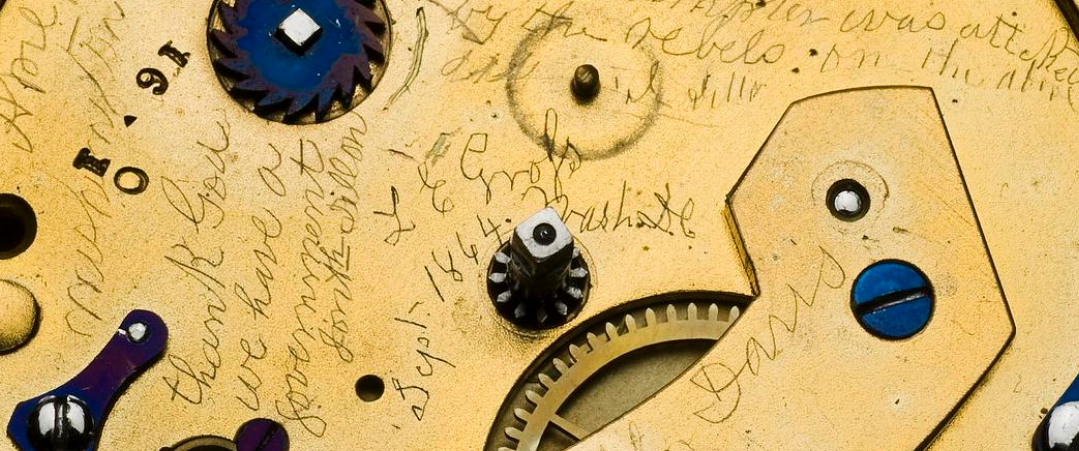
The second artifact that really spoke to me was Abraham Lincoln's gold pocket watch. Lincoln purchased the watch in the late 1850s, and sent his watch to M.W. Galt & Company for repairs when he arrived in Washington in 1861. His watch changed forever when news of the bombardment of Fort Sumter arrived in the city on April 13, 1861. Jonathan Dillon, the watchmaker repairing the watch at that time, decided on that day to inscribe a message on the inner workings of the watch with a sharp metal instrument. He recorded the news of Fort Sumter, set down his name and the date, and wrote "thank God we have a government." Through the years, other watchmakers who had the opportunity to view the inner workings of Mr. Lincoln's watch also added their own inscriptions, including one who wrote "Jeff Davis." Lincoln probably never knew of the secret messages inside his pocket watch. Incredibly, the story of the messages inside the watch was passed down through Dillon's family over the years. Staff at the National Museum of American History never had any cause to uncover the inner workings of the watch, and knew nothing of Dillon's story. In 2009, descendents of Dillon contacted the Smithsonian about the watch, and on March 10, 2009, the inscriptions were revealed to Dillon's family, reporters, and museum staff.

These are just two of an array of incredible pieces from the National Collection highlighted. If you are like me, and you appreciate the power objects have to convey meaningful stories, you will enjoy this book.

Monday, November 18, 2013

Museum Merger: Museum of the Confederacy and American Civil War Center

Yesterday brought some big news in Richmond. The Museum of the Confederacy and the American Civil War Center at Historic Tredegar plan to merge and create a new, $30 million museum at Tredegar Iron Works. S. Waite Rawls III, president and CEO of the Museum of the Confederacy, and Christy Coleman, president of the American Civil War Center, will co-lead the new organization, which has no name as of yet. Civil War scholar and University of Richmond President Ed Ayers sits on the board of both organizations and will serve as the first chairman of the combined board. According to the Richmond Times-Dispatch, more than two-thirds of the money for the new 30,000 square foot museum has already been committed. 

This merger, which is bound to draw its fair share of controversy, comes after the Museum of the Confederacy has faced a number of challenges in recent years. The museum's attendance has declined from around 90,000 in the mid-90s to about 40-50,000 today. The constant congestion and construction resulting from the expansion of its neighbor, the Virginia Commonwealth University Medical Center, has made visiting the museum difficult. After the merger, The Confederate White House, part of the Museum of the Confederacy complex, will remain open at its present site.

I find a ton of great possibilities with this merger. Ayers was quoted in the Times-Dispatch article as saying:
I think it’s going to be a great thing for the city, it’s going to be a great thing for people who care about the Civil War and it’s going to be a great thing for people who care about the mission of both institutions, which will be able to be sustained. You have the best collection of Confederate materials in the world and now you’ll have it in a place where they can actually be displayed and esteemed probably more than ever.

Since the 1990s, the Museum of the Confederacy has made strides to break out of its "Lost Cause" roots and tell a more complete picture of the Confederacy, and to interpret slavery. Teaming with an institution whose mission is to "tell the whole story of the conflict that still shapes our nation" can only further that process. Creating a new organization on firm financial footing and with the space and resources to best utilize the Museum of the Confederacy's excellent collection should be great for Richmond. Yet I will find it interesting to see how this merger works out. These types of moves rarely work out seamlessly. When two organizations with separate visions and with separate constituencies merge, there will also be conflict. Personally, I am intrigued to see how well "co-leadership" will work out.

I am rooting for this project's success, and I applaud the leaders of both organizations for attempting this bold step. I look forward to visiting the new museum when it is completed. If you would like to read more about the merger, you can find articles here and here. There has also been coverage on other Civil War blogs, notably from Kevin Levin and Emmanuel Dabney.

Thursday, October 10, 2013

James Madison's Montpelier


Well, here I am in Virginia. After spending the last seven years in central New York, a five and a half hour drive from the Gettysburg battlefield, I now find myself three hours away, and less than a two hour drive from virtually every major battlefield in the state of Virginia. And just when I arrive, the government shuts down all National Park Service sites, and I find myself unable to take advantage of my new-found proximity.

Of course that's not entirely true. There are many Civil War sites in Virginia not operated by the National Park Service that remain open, as the Emerging Civil War blog has continued to demonstrate throughout the government shutdown. This part of Virginia also boasts a number of other historic sites unrelated to the Civil War. Yesterday - I took some time to explore one of them - James Madison's Montpelier.

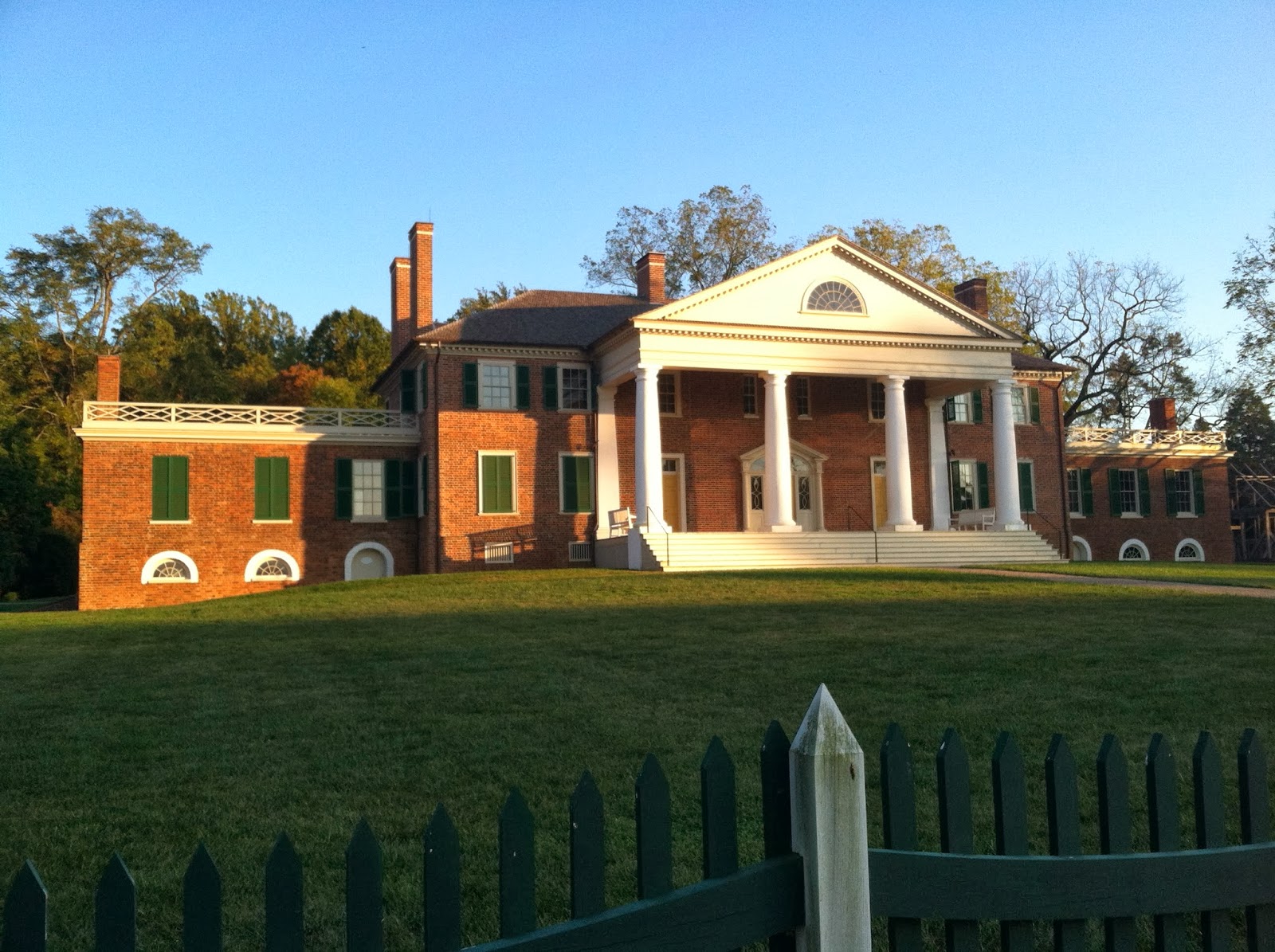
Located just outside of Orange, Virginia, Montpelier is set in the foothills of the Blue Ridge Mountains. This property has a unique history. The Madison family owned the estate for more than 120 years, from 1723 until 1844. Ambrose Madison, James's grandfather, first moved to the property with his family and about 29 slaves in 1732, establishing a plantation. James Madison Sr. expanded his father's tobacco plantation, and in the early 1760s he began construction of a new house - today known as Montpelier. His eldest son, James Madison Jr., "the father of the Constitution," inherited the estate, and, despite frequent absences due to his political career, called Montpelier his home throughout his entire life. He died there in 1836. Eight years later, Dolley Madison sold the property.

A gorgeous view of the Blue Ridge from Madison's front doorstep.
In 1901 William and Annie Rogers duPont acquired Montpelier, and it remained in the duPont family until Marion duPont Scott bequeathed it to the National Trust for Historic Preservation upon her death in the 1980s. Under the duPonts the estate became a horse farm,  and during this time the home also underwent several dramatic expansions and alterations. Since 2003, the Montpelier Foundation has taken on an ambitious effort to return the home to the way it looked circa 1820 - the years of James Madison's retirement.

My experience began with a short film at the Visitor's Center, introducing the story of James Madison and establishing his importance as the most powerful voice at the Constitutional Convention of 1787. Following the film, I joined about 20 other visitors for a 45-minute guided tour of the house. The furnishings in the house at this point are fairly sparse. With the exterior renovations completed in 2008, the curators at Montpelier are currently in the middle of an on-going effort to research each room of the house to determine how the rooms may have appeared during Madison's time. Some of the rooms are more complete than others, but the historical detective work in itself is a fascinating tale. The guided tour ends in Madison's library on the second floor. Unfurnished at the moment, this room is slated to be restored this winter. Currently, the bare room features one wall with quotes from famous political philosophers juxtaposed with James Madison quotes about the Constitution. It was in this room in the winter of 1786 that Madison spent hours pouring over volumes of political thought in preparation for the upcoming Convention in Philadelphia. As such, it can be said to be the room in which the first outlines of the Constitution began to take shape. The rest of the second floor is devoted currently to a temporary exhibit on the War of 1812.

In addition to the house tour, visitors can explore much more on the estate. Interpretive signage and pathways provide information on the enslaved community at Montpelier, including reconstructed frames of the domestic slave quarters, and markers outlining the field slave quarters and the site of one of Montpelier's slave cemeteries. At any one time, the plantation would have been home to upward of a hundred slaves. The Montpelier Foundation has made extensive use of archeological investigations to learn more about the estate and the people who called it home. These investigations are ongoing, and as I traversed the estate I passed several archeologists at work. Evidence of the duPont era remains as well, including a beautiful terraced garden that you can stroll through, and the horse farm itself. Today, Montpelier maintains a partnership with the Thoroughbred Retirement Foundation, and a portion of the estate operates as a farm for thoroughbred horses. Two race courses still remain, and a steeplechase event is held here every November. The Montpelier Visitor Center also offers several exhibits about Madison, Montpelier, and the duPonts. Unfortunately, I did not have a chance yesterday to check out these exhibits.

Finally, to at least make an attempt to tie this post to the Civil War, I should point out that the estate does have some Civil War history associated with it, though I have yet to exlpore it. In 2002 archeologists located the remains of the winter quarters of General Samuel McGowan's South Carolians during the winter of 1863/1864. McGowans soldiers remained in camp at this location until May 4th, 1864, departing to confront the Army of the Potomac as it crossed the Rapidan River and entered the Wilderness. Today, you can hike Montpelier's Civil War trail, which winds its way to reconstructed huts near where McGowan's men camped. The trail eventually finds its way to the cabin of George Gilmore. Gilmore was born into slavery at Montpelier around 1810. Freed by the 13th Amendment, Gilmore built a cabin at this site from materials scavenged from the desserted Confederate camp. The cabin was restored in 2005 by the Montpelier Foundation to interpret the transition from slavery to freedom that many African Americans faced at the close of the Civil War.

In all, James Madison's Montpelier is certainly worth your time if you have the opportunity to go. The many layers of history at this estate, and the ongoing efforts to uncover those layers, make it much more than a traditional historic house experience. If you can't explore in person, Montpelier also has an excellent smart phone app that allows you to explore digitally.

Tuesday, July 16, 2013

A Brief Stop in Auburn

This past weekend I traveled to Buffalo for a wedding. The return trip on Sunday afternoon included a detour to Auburn to visit the house of William H. Seward, famed New York politician and Secretary of State under Abraham Lincoln and Andrew Johnson. I don't think historians have ever truly relegated Seward to the shadows, but in recent years there has been a bit of a renaissance of scholarship, including Dorris Kearns Goodwin's Team of Rivals, and just last year, Walter Starh's biography, Seward: Lincoln's Indispensable Man. The Seward House has had its fair share of attention recently as well, most of it stemming from the controversy surrounding an original Thomas Cole painting that once had a prominent place on the first floor.

The house was built in 1816 by Elijah Miller, Seward's future father-in-law. When William married Frances Seward, her father consented on the condition that the couple would continue to reside at the house. William called this place home for the rest of his life, though he was absent from it frequently and for long stretches of time. During his political career Seward traveled the world and rented homes in Albany and in Washington, but his home in Auburn was the only one he ever owned. For her part, Frances Seward rarely left Auburn, choosing to remain there rather than joining her husband in Washington.

If you are ever traveling through this area of New York State, this house tour is worth allocating a few hours. The visitor experience at the Seward House mirrors traditional historic house tours. Aside from a few areas, the house is only open to tours guided by museum staff and volunteers. We arrived  a bit after 1:00 p.m., and had some time to kill before the next tour of the house began at 2. We headed down to the basement of the house where a small but extremely well-done panel exhibit told the story of the Seward Family and the Underground Railroad. Seward cultivated a national reputation through the 1850s as one of the preeminent antislavery voices in the Senate, but less well known is that Seward backed up his rhetoric with action. Despite significant political risk, solid evidence reveals that the Seward family assisted fugitive slaves seeking to escape to Canada, and harbored at least two fugitives in their home at Auburn. Seward also sold property in town to Harriet Tubman. The exhibit also discussed the rest of the Seward family's positions on slavery, particularly his wife Frances and daughter Fanny. Frances, raised as a Quaker and educated at Emma Willard in Troy, New York, was even more radical than her husband when it came to slavery.

At two, our tour began, and a college student from Washington College in Maryland led us through the various rooms of the house, beginning on the first floor with the drawing room, library, and an expansive dining room. Recounting Seward's status as an excellent host, it was easy to imagine the dining room filled with cigar smoke and tumblers of brandy while Seward cultivated important political connections. The house is filled with an amazing collection of Seward family artifacts. Many of these pieces are original to the home, but many more also came from Seward's home in Washington. Included are several original portraits and other paintings created by Emanuel Leutze, a friend of the family, and the painter of "Washington Crossing the Delaware."

The second floor of the home included several period bedrooms, and two rooms set up to display various family artifacts, one room called "The Alaska Room," the other called "The Civil War Room." Some of the incredible items featured in the Civil War Room included uniforms worn by Seward's sons during the Civil War, the New York State flag carried by William H. Seward Jr.'s regiment, the 9th New York Heavy Artillery, portions of the bloody sheet from Lewis Powell's assassination attempt, and pressed flowers from Abraham Lincoln's coffin, given to Seward by Mary Todd Lincoln. Meanwhile, the Alaska Room contained several masks related to the native cultures of Alaska, and a gold ring, one of only five made from the golden spike that connected the Transcontinental Railroad.

The hallway of the second floor also contained a very unique feature. In this space Seward himself numbered and hung nearly two hundred portraits of noteworthy individuals. I believe the guide said that Seward had personally met all but two of those pictured. Lincoln's portrait Seward hung as number 66. Significantly, Seward hung his own portrait as 66 1/2, a symbol of how close the two became, or perhaps how close Seward came to the Presidency in 1860.

This stately home tucked away in upstate New York contains some incredible treasures related to one of the most significant political figures of the 19th Century. If you happen to be in the area, it's well worth a visit.