The Iron Brigade: A Military History
By Alan T. Nolan
Published 1983 (First Edition 1961) by the Historical Society of Michigan
Over the past few years, I've developed quite an interest in the Iron Brigade. My curiosity in the Army of the Potomac's elite Westerners first began when I waded into Alan D. Gaff's On Many a Bloody Field: Four Years in the Iron Brigade, an excellent and exhaustive study of Company B, 19th Indiana. Gettysburg National Military Park's now-retired supervisory historian Scott Hartwig continued to fan those flames of curiosity. At Gettysburg's Sesquicentennial in July of 2013, I attended his excellent interpretive program entitled "The Last March of the Iron Brigade." While retracing the steps of the brigade, Hartwig spoke of his favorite war recollection, Service with the Sixth Wisconsin Volunteers by Rufus Dawes. On this recommendation, I later picked up Dawes's amazing account, and it didn't disappoint.
As my interest developed, I became keenly aware of a glaring gap in my knowledge of Iron Brigade (not to mention general Civil War) historiography: I had not yet picked up the late Alan T. Nolan's classic, The Iron Brigade: A Military History. I rectified this situation late last year, when I found a copy for sale at my favorite used book store, and I snapped it up. Finally, over Christmas, I buried my nose into Nolan's descriptive accounts of the standup fight at the Brawner Farm, of the horrific morning along the Hagerstown Pike at Antietam, and of the brigade's "last stand" at the hastily built barricade on Seminary Ridge at Gettysburg.
For a book that first appeared in 1961, it has withstood the test of time. Nolan's treatment of this famed brigade is comprehensive and complex. Rather than obsessing over the minutiae of battlefield tactics and maneuvers, the author's success lies in his ability to make his story a human drama. Through the book I came to know the men, and especially the officers, of the 2nd, 6th, and 7th Wisconsin, the 19th Indiana, and the 24th Michigan. I learned about their home towns and their motivations for fighting. I contemplated their thoughts on Union and emancipation, and began to understand the importance of politics and political connections in army life. I read about the daily experiences of soldiers in camp and on campaign, and recognized how discipline, rewards and punishments, and unit pride all contributed to the brigade's development into one of the best fighting forces of the war. In thoroughly acquainting his readers with the officers and soldiers of the Iron Brigade first, Nolan lent more power to his account when he brought them to the battlefield.
It would be difficult to find a unit anywhere with a more impressive combat record than the Iron Brigade. During the war, Confederate regiments that faced the brigade in the field without exception suffered astounding casualties. Correspondingly, the Iron Brigade lost a higher percentage of soldiers killed in combat than any other Federal unit. At Gettysburg, the westerners left nearly two-thirds of their number on the field, the greatest proportion of Union casualties in the war's largest battle.
In total, Alan Nolan's The Iron Brigade continues to serve as a model for a comprehensive, modern, unit history. My only regret is that this book wasn't longer. Nolan chose to essentially wrap his book up after Gettysburg, noting that battle casualties, expiring enlistments, and army reorganization destroyed the original fabric of the brigade. He summarized the record of the brigade between Gettysburg and Appomattox with a short epilogue chapter. While I understand why Nolan made this choice, the post-Gettysburg period of the brigade's history is one that I think is worthy of a more expansive study. I found myself wanting to know more about how the soldiers of the brigade coped with the increasing stresses of combat fatigue, the uncertainty of fighting alongside new recruits and draftees of unknown quality, and the challenges to morale when external forces disrupted unit cohesion and pride. This one critique aside, I would recommend this highly readable account as one of the very best unit histories that I've read.
I also note that, though scholarship is always evolving and improving, the popular history and popular culture related to the Civil War even today tends to focus on political and military leadership at the highest levels, men like Abraham Lincoln, Robert E. Lee, and Ulysses S. Grant. While I recognize the importance of studying their decisions and actions, I have personally become increasingly interested in learning about the war from a lower vantage point: from the view of soldiers and field officers at the regimental and brigade level. And as someone who thoroughly enjoyed HBO's Band of Brothers miniseries, I wonder if and when someone might take on a similar type of project focused on a Civil War unit. While I hesitate to trust Hollywood once again in the telling of a Civil War epic, I can't say I wouldn't be excited to see someone like Tom Hanks and Steven Spielberg bring the story of the Iron Brigade to the big screen. Just a thought.
Showing posts with label Library Corner. Show all posts
Tuesday, January 6, 2015
Monday, September 22, 2014
Library Corner: The Last Battle of Winchester
The Last Battle of Winchester: Phil Sheridan, Jubal Early, and the Shenandoah Valley Campaign, August 7-September 18,1864.
By Scott C. Patchan
Published in 2013 by Savas Beatie
Though silent on the blog for some time now, I've maintained my activity on the reading front. Just this past week, as we commemorated the 150th anniversary of Third Winchester, I finished reading Scott C. Patchan's recent book, The Last Battle of Winchester: Phil Sheridan, Jubal Early, and the Shenandoah Valley Campaign, August 7-September 18, 1864.
I must admit that I had little knowledge of the 1864 Valley Campaign prior to this book. What I knew I had I gleaned off of general Civil War overviews, biographies and memoirs of participants in the campaign, and a handful of visits to sites like New Market and Cedar Creek. Given my sparse knowledge of the topic, this book has been high on my "to read" list for quite some time. When I finally had a chance to pick it up, I wasn't disappointed.
Patchan has produced a fine campaign study, providing his readers with a blow-by-blow account of the Battle of Third Winchester. While he delves into the details of combat and evaluates the performances of key subordinates on both sides, Patchan focuses much of his book on a close analysis of the leadership qualities of the opposing commanders, Phil Sheridan and Jubal Early. He studies their successes and failures, both strategically and operationally.
In Jubal Early, Patchan sees a commander with an excellent combat record, and one who had already seen tremendous success facing long odds as an independent commander in the Valley. And yet, Patchan faults Early for misreading his enemy's intentions in advance of the September 19th battle. Early's daring decision to split his army in the face of overwhelming odds put his troops in unnecessary danger, and suggests that the Rebel commander's disdain for his enemy clouded his judgment.
On the federal side, Patchan provides an excellent analysis of the political implications of the Valley Campaign. While many historians have often portrayed Sheridan as a rash and sometimes reckless commander, Patchan finds that in the fall of 1864, Sheridan acted with commendable patience and prudence. In fact, one could say that Sheridan acted with too much caution. Understanding the charged atmosphere of election-year politics, the Lincoln Administration and Sheridan's boss, Ulysses S. Grant, worried about the ramifications of another defeat in "the Valley of Humiliation." Keenly grasping the political realities of his position, Sheridan spent much of September waiting for his counterpart to detach forces before striking. Once those forces, under command of General Richard Anderson, did leave the valley, Sheridan unleashed his offensive.
Little Phil's battle plan contained several flaws tactically. Patchan points out that the Union general did not take advantage of all the potential avenues of approach for his army on September 19th, slowing his army's advance and forcing it to attack through disadvantageous ground. He also failed to deploy cavalry in positions to effectively protect the flanks of his advancing infantry. And yet, Patchan praises Sheridan's persistence, inspirational battlefield leadership, and his willingness to use the entirety of his army. He highlights all three of these as qualities that defined the Union army's success at Third Winchester, and became a trademark of Sheridan's future successes. In fact, Patchan argues that Sheridan's dramatic ride through the front lines of his advancing army on September 19th not only spurred his soldiers on to victory, but set the stage his army's morale and inspiration at the Battle of Cedar Creek a month later.
Through Patchan's narrative of the Battle of Third Winchester, the abilities of Sheridan's subordinates also shine through. He highlights in particular the performances of George Crook, David Russell (killed on the battlefield), and Emory Upton. Federal cavalry soldiers also star in this book, in particular Wesley Merritt, George Armstrong Custer, and William Averell. Patchan describes the evolution of the cavalry under Sheridan into a powerful strike force capable of standing toe to toe with Confederate infantry. In the end, Patchan argues that the overwhelming superiority of Federal horse soldiers perhaps served as the critical component that spelled the doom of Early's Army of the Valley.
Patchan concludes his book with a strong argument for why the Third Battle of Winchester matters. It was here along the banks of Opequon Creek that the seeds of the defeat of the Confederacy were sown. This battle set the stage for Fisher's Hill and Cedar Creek, and the ultimate destruction of Early's Army. This trio of defeats went a long way toward ensuring Lincoln's reelection. They also closed off the Shenandoah Valley once and for all to the Confederacy, and allowed Sheridan's victorious army to return to the Petersburg front. The following spring, it is forces led by Sheridan, and in particular his powerful mounted strike force, that land the mortal blows to Robert E. Lee's army in March and April of 1865.
Scott Patchan's The Last Battle of Winchester is well written, contains excellent maps, and well-chosen illustrations and photographs throughout. It is well worth your time.
By Scott C. Patchan
Published in 2013 by Savas Beatie
Though silent on the blog for some time now, I've maintained my activity on the reading front. Just this past week, as we commemorated the 150th anniversary of Third Winchester, I finished reading Scott C. Patchan's recent book, The Last Battle of Winchester: Phil Sheridan, Jubal Early, and the Shenandoah Valley Campaign, August 7-September 18, 1864.
I must admit that I had little knowledge of the 1864 Valley Campaign prior to this book. What I knew I had I gleaned off of general Civil War overviews, biographies and memoirs of participants in the campaign, and a handful of visits to sites like New Market and Cedar Creek. Given my sparse knowledge of the topic, this book has been high on my "to read" list for quite some time. When I finally had a chance to pick it up, I wasn't disappointed.
Patchan has produced a fine campaign study, providing his readers with a blow-by-blow account of the Battle of Third Winchester. While he delves into the details of combat and evaluates the performances of key subordinates on both sides, Patchan focuses much of his book on a close analysis of the leadership qualities of the opposing commanders, Phil Sheridan and Jubal Early. He studies their successes and failures, both strategically and operationally.
In Jubal Early, Patchan sees a commander with an excellent combat record, and one who had already seen tremendous success facing long odds as an independent commander in the Valley. And yet, Patchan faults Early for misreading his enemy's intentions in advance of the September 19th battle. Early's daring decision to split his army in the face of overwhelming odds put his troops in unnecessary danger, and suggests that the Rebel commander's disdain for his enemy clouded his judgment.
On the federal side, Patchan provides an excellent analysis of the political implications of the Valley Campaign. While many historians have often portrayed Sheridan as a rash and sometimes reckless commander, Patchan finds that in the fall of 1864, Sheridan acted with commendable patience and prudence. In fact, one could say that Sheridan acted with too much caution. Understanding the charged atmosphere of election-year politics, the Lincoln Administration and Sheridan's boss, Ulysses S. Grant, worried about the ramifications of another defeat in "the Valley of Humiliation." Keenly grasping the political realities of his position, Sheridan spent much of September waiting for his counterpart to detach forces before striking. Once those forces, under command of General Richard Anderson, did leave the valley, Sheridan unleashed his offensive.
Little Phil's battle plan contained several flaws tactically. Patchan points out that the Union general did not take advantage of all the potential avenues of approach for his army on September 19th, slowing his army's advance and forcing it to attack through disadvantageous ground. He also failed to deploy cavalry in positions to effectively protect the flanks of his advancing infantry. And yet, Patchan praises Sheridan's persistence, inspirational battlefield leadership, and his willingness to use the entirety of his army. He highlights all three of these as qualities that defined the Union army's success at Third Winchester, and became a trademark of Sheridan's future successes. In fact, Patchan argues that Sheridan's dramatic ride through the front lines of his advancing army on September 19th not only spurred his soldiers on to victory, but set the stage his army's morale and inspiration at the Battle of Cedar Creek a month later.
Through Patchan's narrative of the Battle of Third Winchester, the abilities of Sheridan's subordinates also shine through. He highlights in particular the performances of George Crook, David Russell (killed on the battlefield), and Emory Upton. Federal cavalry soldiers also star in this book, in particular Wesley Merritt, George Armstrong Custer, and William Averell. Patchan describes the evolution of the cavalry under Sheridan into a powerful strike force capable of standing toe to toe with Confederate infantry. In the end, Patchan argues that the overwhelming superiority of Federal horse soldiers perhaps served as the critical component that spelled the doom of Early's Army of the Valley.
Patchan concludes his book with a strong argument for why the Third Battle of Winchester matters. It was here along the banks of Opequon Creek that the seeds of the defeat of the Confederacy were sown. This battle set the stage for Fisher's Hill and Cedar Creek, and the ultimate destruction of Early's Army. This trio of defeats went a long way toward ensuring Lincoln's reelection. They also closed off the Shenandoah Valley once and for all to the Confederacy, and allowed Sheridan's victorious army to return to the Petersburg front. The following spring, it is forces led by Sheridan, and in particular his powerful mounted strike force, that land the mortal blows to Robert E. Lee's army in March and April of 1865.
Scott Patchan's The Last Battle of Winchester is well written, contains excellent maps, and well-chosen illustrations and photographs throughout. It is well worth your time.
Wednesday, August 20, 2014
Library Corner: A Few Battlefield Guides
As you might have guessed, my day job has kept me quite busy over the last month or two. Hence the lack of posts. Though I haven't had much time for blogging, I have squeezed in a few battlefield visits. At the end of July I spent a full day hiking at Manassas National Battlefield, while this past weekend I visited sites on the Petersburg National Battlefield and at Pamplin Park.
I have visited the Manassas National Battlefield before, though it's been nearly a decade and I never had much of a chance to take advantage of the park's forty-plus miles of trails. On the last weekend of July, I decided to change that. Armed with plenty of water and snacking provisions, a trail guide obtained at the Visitor Center, a copy of John Hennessy's Return to Bull Run, and the Civil War Trust's Second Manassas App on my phone, I set off on the 6.2 mile Second Manassas trail. This loop trail starts on Henry House Hill and covers most of the battlefield, including the Stone House, Buck Hill, a good portion of the Unfinished Railroad Cut, Groveton, and Chinn Ridge. I opted to hike an extra mile or two by adding on the Brawner Farm loop. All told, I was able to cover most of ground the battle was fought over - from the opening shots on the Brawner Farm on August 28th, 1862, to John Pope's attacks against the Railroad Cut on the 29th and 30th, and concluding fittingly with James Longstreet's counterattack that swept Pope's army from the field on the afternoon of the 30th.
When I finished my tour, I had just enough time to poke my head into the Visitor Center's bookstore. Here I picked up a nice looking guidebook for my next visit: Ethan Rafuse's Manassas: A Battlefield Guide. This book came out in 2014 as part of the University of Nebraska's This Hallowed Ground: Guide to Civil War Battlefields series. Though I wasn't able to use it on the field, I spent quite a few days after my visit perusing the guidebook, and it looks quite useful. The book contains detailed battlefield tours of both First and Second Manassas, as well as campaign excursions that guide you to sites further afield from the National Park. Each stop contains several subsection headings, including: directions, orientation, what happened, analysis, vignette, and further reading. The book also contains numerous illustrations and superb maps drawn by Erin Greb.
I found myself pouring over the book for days after my visit. Those who cannot make it to Second Manssas will assuredly find it a useful resource, but the book is intended for use on the battlefield, and I can't wait to find an excuse to get back to Manassas with it in hand.
Just this past weekend, I took a trip down to Petersburg, another battlefield that I have not visited in nearly a decade. My wife came along for the ride - her first visit. We started our day poking around at the Eastern Front Visitor Center, and then followed the Eastern Front driving tour, getting out of car at several points to follow some of the short interpretive trails. We utilized the Civil War Trust's Petersburg App. I really cannot say enough good things about the various battlefield apps that the Civil War Trust has developed - they are incredibly useful on the battlefield.
After following the interpretive trail around the Crater, we took a break for lunch. While we had originally planned to continue our tour by visiting the various forts of the Western Front, but the day was quite hot and humid, and we decided instead to spend our afternoon visiting Pamplin Park and the National Museum for the Civil War Soldier. I've always enjoyed the museum here, and thought it'd be a good way to beat the heat. For those have not visited, all guests receive an audio headset to guide them through the museum. As you enter each room, the audio player automatically begins to play an overview of the exhibit. Once the overview is done, you can enter numbers to learn more about any of the displays. Meanwhile, you are also assigned a particular soldier before entering the exhibit area, and as you progress through the museum special kiosks enable you to learn more about the soldier you've chosen to follow, through the soldiers own words and other primary sources. The museum hasn't changed much since my first visit ten years ago, but I still found it as enjoyable.
Outside of the museum, Pamplin Park preserves and interprets Tudor Hall Plantation and the site of the Battle of the Breakthrough on April 2nd, 1865. Tudor Hall was the home of the Boisseau family. Here they interpret not only life on an antebellum plantation, but also Tudor Hall's use as a Confederate encampment during the winter of 1864-1865. Visitors can take advantage of a number of programs and tours offered by living historians. We decided to simply use our audio guides as we traversed the plantation and the Breakthrough Trail, where we explored the Confederate earthworks that were carried by the Army of the Potomac's Sixth Corps, ending the Siege of Petersburg.
To cap off the day, I took some time once again to browse Pamplin Park's bookstore, and located another battlefield guide, this time a Guide to the Richmond-Petersburg Campaign, edited by Charles R. Bowery, Jr. and Ethan Rafuse (again). This book features maps by the ubiquitous Steve Stanley. Also published in 2014 (by the University of Kansas), this guide is a bit different from the Manassas Guide. As part of the U.S. Army War College Guides to Civil War Battles series, it is much more in-depth and designed for the serious student of military history. Clocking in at more than 400 pages, the book features two parts: part one explores the main portion of Petersburg National Battlefield, or the Eastern Front. Part two offers several excursion tours, including City Point, sites north of the James River outside of Richmond, and sites associated with Grant's westward movements and the fall of Petersburg.
At each stop, the book provides a brief overview of events, orienting the visitor and situating the combat in that particular area into the context of the overall siege. After these brief explanations, each stop then provides a series of lengthy battle accounts designed to be read while viewing the terrain. Most of these accounts are from the Official Records, and they are a mix of voices from the strategic and operational leadership of both armies.
I've enjoyed browsing through both battlefield guides, and look forward to using them on the field.
![]() |
| View looking over the Stone House and toward Buck Hill and Matthew's Hill at Manassas. |
I have visited the Manassas National Battlefield before, though it's been nearly a decade and I never had much of a chance to take advantage of the park's forty-plus miles of trails. On the last weekend of July, I decided to change that. Armed with plenty of water and snacking provisions, a trail guide obtained at the Visitor Center, a copy of John Hennessy's Return to Bull Run, and the Civil War Trust's Second Manassas App on my phone, I set off on the 6.2 mile Second Manassas trail. This loop trail starts on Henry House Hill and covers most of the battlefield, including the Stone House, Buck Hill, a good portion of the Unfinished Railroad Cut, Groveton, and Chinn Ridge. I opted to hike an extra mile or two by adding on the Brawner Farm loop. All told, I was able to cover most of ground the battle was fought over - from the opening shots on the Brawner Farm on August 28th, 1862, to John Pope's attacks against the Railroad Cut on the 29th and 30th, and concluding fittingly with James Longstreet's counterattack that swept Pope's army from the field on the afternoon of the 30th.
![]() |
| The position of Stephen D. Lee's Confederate artillery, which was so effective against Pope's assaults on the Railroad Cut. |
When I finished my tour, I had just enough time to poke my head into the Visitor Center's bookstore. Here I picked up a nice looking guidebook for my next visit: Ethan Rafuse's Manassas: A Battlefield Guide. This book came out in 2014 as part of the University of Nebraska's This Hallowed Ground: Guide to Civil War Battlefields series. Though I wasn't able to use it on the field, I spent quite a few days after my visit perusing the guidebook, and it looks quite useful. The book contains detailed battlefield tours of both First and Second Manassas, as well as campaign excursions that guide you to sites further afield from the National Park. Each stop contains several subsection headings, including: directions, orientation, what happened, analysis, vignette, and further reading. The book also contains numerous illustrations and superb maps drawn by Erin Greb.
![]() |
| Monument to the 5th New York - Duryee's Zouaves. In just a short ten minutes, this regiment lost 332 men of 525 engaged. Of these 121 were killed or mortally wounded. |
I found myself pouring over the book for days after my visit. Those who cannot make it to Second Manssas will assuredly find it a useful resource, but the book is intended for use on the battlefield, and I can't wait to find an excuse to get back to Manassas with it in hand.
Just this past weekend, I took a trip down to Petersburg, another battlefield that I have not visited in nearly a decade. My wife came along for the ride - her first visit. We started our day poking around at the Eastern Front Visitor Center, and then followed the Eastern Front driving tour, getting out of car at several points to follow some of the short interpretive trails. We utilized the Civil War Trust's Petersburg App. I really cannot say enough good things about the various battlefield apps that the Civil War Trust has developed - they are incredibly useful on the battlefield.
| Monument to the 1st Maine Heavy Artillery. In their charge on June 18th, 1864, this unit suffered 604 casualties. |
Outside of the museum, Pamplin Park preserves and interprets Tudor Hall Plantation and the site of the Battle of the Breakthrough on April 2nd, 1865. Tudor Hall was the home of the Boisseau family. Here they interpret not only life on an antebellum plantation, but also Tudor Hall's use as a Confederate encampment during the winter of 1864-1865. Visitors can take advantage of a number of programs and tours offered by living historians. We decided to simply use our audio guides as we traversed the plantation and the Breakthrough Trail, where we explored the Confederate earthworks that were carried by the Army of the Potomac's Sixth Corps, ending the Siege of Petersburg.
To cap off the day, I took some time once again to browse Pamplin Park's bookstore, and located another battlefield guide, this time a Guide to the Richmond-Petersburg Campaign, edited by Charles R. Bowery, Jr. and Ethan Rafuse (again). This book features maps by the ubiquitous Steve Stanley. Also published in 2014 (by the University of Kansas), this guide is a bit different from the Manassas Guide. As part of the U.S. Army War College Guides to Civil War Battles series, it is much more in-depth and designed for the serious student of military history. Clocking in at more than 400 pages, the book features two parts: part one explores the main portion of Petersburg National Battlefield, or the Eastern Front. Part two offers several excursion tours, including City Point, sites north of the James River outside of Richmond, and sites associated with Grant's westward movements and the fall of Petersburg.
At each stop, the book provides a brief overview of events, orienting the visitor and situating the combat in that particular area into the context of the overall siege. After these brief explanations, each stop then provides a series of lengthy battle accounts designed to be read while viewing the terrain. Most of these accounts are from the Official Records, and they are a mix of voices from the strategic and operational leadership of both armies.
I've enjoyed browsing through both battlefield guides, and look forward to using them on the field.
Sunday, June 1, 2014
Library Corner: Service with the Sixth Wisconsin Volunteers.
![]() |
| Rufus Dawes. Library of Congress. |
Today, I finished reading Service with the Sixth Wisconsin Volunteers, Rufus Dawes's personal memoir of his experiences as an officer in the Iron Brigade. This book has been high on my reading list ever since the Sesquicentennial of Gettysburg last July, when Scott Hartwig called it his favorite Civil War book during his interpretive program on the Iron Brigade. Hartwig's recommendation didn't disappoint.
Service with the Sixth Wisconsin Volunteers is part memoir, part diary, and mostly large selections of Dawes's own letters written to his wife during the war. While he weaves together his wartime writings with postwar analysis, Dawes lets his primary sources speak for themselves for the most part, interjecting only to provide needed context or explanation. I have sometimes found the writing style of many postwar memoirs and regimental histories somewhat dry, but Dawes clearly had a talent for writing that shines throughout this book and makes it a pleasure to read.
Dawes fought in the best-known brigade in the Army of the Potomac. He somehow managed to avoid getting wounded during his service despite his participation in more than twenty battles, including some of the bloodiest and most well-known struggles of the war. His narrative includes detailed accounts of the fighting in the Bloody Cornfield at Antietam, and of the 6th Wisconsin's charge on the Railroad Cut at Gettysburg. Yet it is not necessarily the battle accounts that sets this book apart. When Walt Whitman wrote that "the real war will never get in the books," I imagine he had in mind just the type of story that Dawes manages to tell. While so many Civil War books--primary and secondary--focus on battles and campaigns, Service with the Sixth Wisconsin Volunteers powerfully reveals the experiences of the war from a deeply personal perspective.
Through Dawes's letters, the reader is able to experience life in the Sixth Wisconsin in camp, on campaign, and in battle. We learn how close brotherly ties between comrades developed over time through shared experiences. It is through these close ties and shared experiences that regiments like the 6th Wisconsin became so fierce and dependable in combat. If you've ever wondered at the unflinching bravery referenced in so many Civil War accounts, Dawes gives perhaps the best explanation I've ever read:
The 'Iron Brigade' has a record beyond reproach, and a record it will always maintain, but the 'Iron Brigade' does not crave a battle. A battle to veterans is an awful experience. There is not with our men the headlong recklessness of new men, who start in, acting as though they would rather be shot than not, and then lose their organization and scatter like sheep, but there is a conviction from much experience in fighting, that safety is best had by steadiness, persistence in firing, and most of all by holding together. So, with the inducement of pride, duty, patriotism and personal preservation, they will stand together till the last.We also learn of the psychological traumas of war. No other account I have ever read has allowed me to understand more fully the horror of the Overland Campaign of 1864 for both soldiers and loved ones at home. In this chapter, Dawes places his collection of letters up front and without comment in the order that they were received by his wife (they had married during the winter of 1864). This, he explains, is designed to give his readers "the most graphic as well as the most accurate manner of restoring the experiences of that time." We learn simultaneously not only of the army's progress and of the great slaughter daily occurring, but also of the fear that takes hold of Dawes's loved ones. Upon hearing of the start of the campaign, Dawes's new father-in-law drops everything to proceed to Washington, and then all the way to the front to find any news that he can of the safety of his daughter's husband. "You cannot conceive of the suffering here," Dawes's father-in-law writes from Fredericksburg on May 16th, "Every house, barn and shed is a hospital.... It is impossible to get reliable information from the front.... We know almost nothing, except that on every hand are thousands of brave men suffering and dying." Dawes himself is falsely reported dead in a newspaper account that finds its way all the way to his father.
As the Overland Campaign progresses, the reader can readily sense that the psychological horrors of combat begin to take their toll on Dawes as he commands the Sixth Wisconsin. On May 20th the Lieutenant Colonel writes to his wife: "Your letters came to me truly when I was 'sick with the horrors of war.'" On June 8th, just after Cold Harbor he writes that "it is impossible, for one who has not undergone it, to fully understand the depression of spirits caused by such long, continued, and bloody fighting and work." Dawes also explains to his readers that:
During this unexampled campaign of sixty continuous days, the excitement, exhaustion, hard work and loss of sleep broke down great numbers of men who had received no wounds in battle. Some who began the campaign with zealous and eager bravery, ended it with nervous and feverish apprehension of danger in the ascendancy. Brave men were shielded if their records on other occasions justified another trial, which ordinarily resulted well, but cowards met no mercy. They were dismissed and their names published throughout the land, a fate more terrible than death to a proud spirited soldier.Modern readers can easily begin to recognize in such a description the symptoms of Post-Traumatic Stress Disorder. As for Dawes himself, as more of his comrades die, his letters and accounts begin to reflect on his own strange luck. He wonders aloud why so many have died or been disfigured while his own life has been spared. Eventually, Dawes is offered a promotion to full Colonel with the stipulation that he would need to reenlist for three more years. Instead, he turns the promotion down and resigns from the army in July of 1864.
He concludes his memoir with a very powerful letter written to his wife in December of 1881. By this point, Dawes had become a congressman. He writes:
My dear wife:--I have today worshiped at the shrine of the dead. I went over to the Arlington Cemetery. It was a beautiful morning and the familiar scenes so strongly impressed upon me during my young manhood, were pleasant. Many times that I went over that road, admiring the beautiful city and great white capital, with its then unfinished dome, going to hear the great men of that day in Congress. An ambitious imagination then builded castles of the time when I might take my place there. Now at middle age, with enthusiasm sobered by hard fights and hard facts, I ride, not run with elastic step over the same road, with this ambition at least realized, and with warmth enough left in my heart to enjoy it. My friends and comrades, poor fellows, who followed my enthusiastic leadership in those days, and followed it to the death which by a merciful Providence I escaped, lie here, twenty-four of them, on the very spot where our winter camp of 1861-1862, was located. I found every grave and stood beside it with uncovered head. I looked over nearly the full 16,000 head-boards to find the twenty-four, but they all died alike and I was determined to find all. Poor little Fenton who put his head above the works at Cold Harbor and got a bullet through his temples, and lived three days with his brains out, came to me in memory as fresh as one of my own boys of today, and Levi Pearson, one of the three brothers of Company A, who died for their country in the sixth regiment, and Richard Gray, Paul Mulleter, Dennis Kelly, Christ Bundy, all young men, who fell at my side and under my command. For what they died, I fight a little longer. Over their graves I get inspiration to stand for all they won in establishing our government upon freedom, equality, justice, liberty, and protection to the humblest.There are a lot of first-person accounts of the Civil War out there. But if you are looking for just one to read, you won't go wrong in selecting Rufus Dawes's Service with the Sixth Wisconsin Volunteers.
Sunday, January 5, 2014
Smithsonian Civil War: Inside the National Collection
As the Holidays come to a close, I've spent some time this weekend exploring one of my most welcome gifts - Smithsonian Civil War: Inside the National Collection. Published at the end of 2013 by the Smithsonian Institution and edited by Neil Kagan and Stephen G. Hyslop, this coffee table book highlights 150 Smithsonian artifacts (or artifact sets) related to the Civil War.
The book features nearly four hundred big, glossy pages, filled with high quality photographs and images. An explanatory caption accompanies each artifact, and all 150 entries contain a brief essay, similar to an interpretive label in a museum. The book, as Michelle Delaney writes in its introduction, is "an exhibit between hard covers," designed to trace the full course of a national tragedy - from the growing divide on slavery through Reconstruction and the war's memory - using the best pieces from our national collection.
I'm impressed by the diversity of the material culture on display. This book is far more than a collection of guns, swords, and uniforms. The artifacts tell the story of the Civil War with broad strokes, encompassing the topics of slavery, abolitionism, politics, the armies, the homefront, women at war, technology, and many more. Just like a museum exhibit, the book invites browsing and careful reading alike, and I've done a bit of both.
So far I've sat down and carefully read through about a quarter of the book, and already I've come across several powerful artifacts that could serve as centerpieces in any exhibit exploring the Civil War. Two powerful pieces stand out. First, a blood-stained map of the Mississippi River Basin from the collection of the National Museum of African American History and Culture. The map was found on the body of David Starr Hoyt, an abolitionist murdered by pro-slavery forces outside of Lawrence, Kansas in 1856.
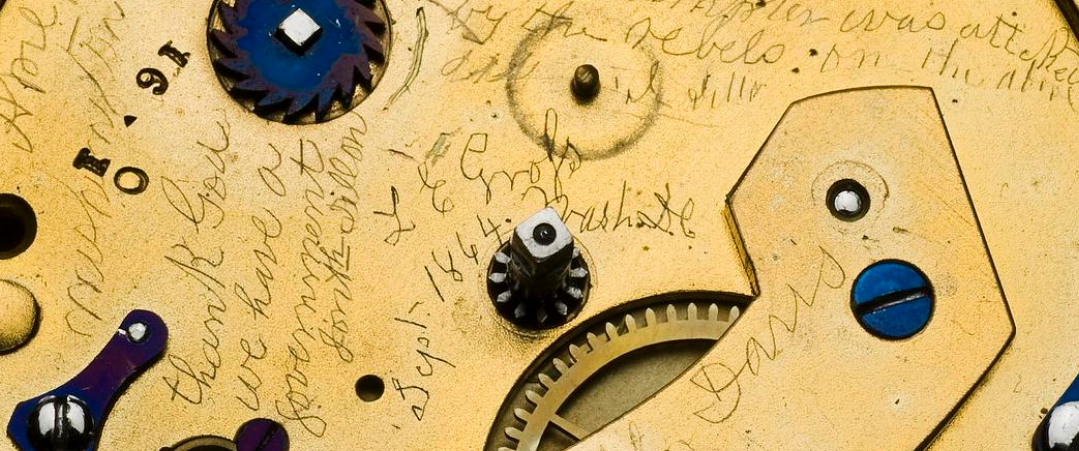
The second artifact that really spoke to me was Abraham Lincoln's gold pocket watch. Lincoln purchased the watch in the late 1850s, and sent his watch to M.W. Galt & Company for repairs when he arrived in Washington in 1861. His watch changed forever when news of the bombardment of Fort Sumter arrived in the city on April 13, 1861. Jonathan Dillon, the watchmaker repairing the watch at that time, decided on that day to inscribe a message on the inner workings of the watch with a sharp metal instrument. He recorded the news of Fort Sumter, set down his name and the date, and wrote "thank God we have a government." Through the years, other watchmakers who had the opportunity to view the inner workings of Mr. Lincoln's watch also added their own inscriptions, including one who wrote "Jeff Davis." Lincoln probably never knew of the secret messages inside his pocket watch. Incredibly, the story of the messages inside the watch was passed down through Dillon's family over the years. Staff at the National Museum of American History never had any cause to uncover the inner workings of the watch, and knew nothing of Dillon's story. In 2009, descendents of Dillon contacted the Smithsonian about the watch, and on March 10, 2009, the inscriptions were revealed to Dillon's family, reporters, and museum staff.
These are just two of an array of incredible pieces from the National Collection highlighted. If you are like me, and you appreciate the power objects have to convey meaningful stories, you will enjoy this book.
The book features nearly four hundred big, glossy pages, filled with high quality photographs and images. An explanatory caption accompanies each artifact, and all 150 entries contain a brief essay, similar to an interpretive label in a museum. The book, as Michelle Delaney writes in its introduction, is "an exhibit between hard covers," designed to trace the full course of a national tragedy - from the growing divide on slavery through Reconstruction and the war's memory - using the best pieces from our national collection.
I'm impressed by the diversity of the material culture on display. This book is far more than a collection of guns, swords, and uniforms. The artifacts tell the story of the Civil War with broad strokes, encompassing the topics of slavery, abolitionism, politics, the armies, the homefront, women at war, technology, and many more. Just like a museum exhibit, the book invites browsing and careful reading alike, and I've done a bit of both.
![]() |
| This blood-stained map powerfully tells the story of Bleeding Kansas. From the Collection of the National Museum of African American History and Culture. |
![]() |
| Abraham Lincoln's Pocket Watch. From the Smithsonian Museum of American History, Kenneth E. Behring Center. |
These are just two of an array of incredible pieces from the National Collection highlighted. If you are like me, and you appreciate the power objects have to convey meaningful stories, you will enjoy this book.
Thursday, January 2, 2014
2013: My Year in Books
As we move into the New Year, I've been looking back on the Civil War books I had a chance to pick up in 2013. My reading list this year included a good mix of political, social and military history. It also featured some of the newest titles from 2012 and 2013, older titles significant to Civil War historiography, and a few primary sources.
Bruce Levine was a repeat author on the list this year. I started the year off with his 2006 book, Confederate Emancipation, and later in the year I picked up his newest work, The Fall of the House of Dixie. In March, I enjoyed Walter Stahr's political biography, Seward: Lincoln's Indispensable Man. Meanwhile, in the way of primary sources, I finally got around to a few essential works that have been on my list for a long time - Gardner's Photographic Sketch Book of the Civil War, All for the Union: The Civil War Diaries and Letters of Elisha Hunt Rhode, and Theodore Lyman's With Grant & Meade: From the Wilderness to Appomattox.
2013 was also a year of campaign histories for me. In addition to rereading a significant portion of my favorite series, Gordon Rhea's books on the Overland Campaign, I went west to read Peter Cozzens' This Terrible Sound: The Battle of Chickamauga. As the 150th anniversary of Gettysburg approached, I made my way through Allen Guelzo's new work, The Last Invasion. But my favorite campaign study, and my favorite read this year overall, was Scott Hartwig's 2012 publication To Antietam Creek. Here's hoping that Mr. Hartwig's retirement will help to speed along volume two.
A lot of intriguing titles came out in 2013 that I could not get to, especially as I devoted the last three months of the year to a crash course in the history of the Early Republic and Thomas Jefferson. Among the 2013 releases that made it to my "to-read" list: Richmond Must Fall by Hampton Newsome, Scott Patchan's The Last Battle of Winchester, and (a bit out of Civil War territory) The Internal Enemy: Slavery and the War in Virginia, 1773-1832 by Alan Taylor.
What were your favorite reads of 2013?
Bruce Levine was a repeat author on the list this year. I started the year off with his 2006 book, Confederate Emancipation, and later in the year I picked up his newest work, The Fall of the House of Dixie. In March, I enjoyed Walter Stahr's political biography, Seward: Lincoln's Indispensable Man. Meanwhile, in the way of primary sources, I finally got around to a few essential works that have been on my list for a long time - Gardner's Photographic Sketch Book of the Civil War, All for the Union: The Civil War Diaries and Letters of Elisha Hunt Rhode, and Theodore Lyman's With Grant & Meade: From the Wilderness to Appomattox.
2013 was also a year of campaign histories for me. In addition to rereading a significant portion of my favorite series, Gordon Rhea's books on the Overland Campaign, I went west to read Peter Cozzens' This Terrible Sound: The Battle of Chickamauga. As the 150th anniversary of Gettysburg approached, I made my way through Allen Guelzo's new work, The Last Invasion. But my favorite campaign study, and my favorite read this year overall, was Scott Hartwig's 2012 publication To Antietam Creek. Here's hoping that Mr. Hartwig's retirement will help to speed along volume two.
A lot of intriguing titles came out in 2013 that I could not get to, especially as I devoted the last three months of the year to a crash course in the history of the Early Republic and Thomas Jefferson. Among the 2013 releases that made it to my "to-read" list: Richmond Must Fall by Hampton Newsome, Scott Patchan's The Last Battle of Winchester, and (a bit out of Civil War territory) The Internal Enemy: Slavery and the War in Virginia, 1773-1832 by Alan Taylor.
What were your favorite reads of 2013?
Monday, August 26, 2013
Library Corner: The Fall of the House of Dixie
This weekend I finished up Bruce Levine's new book, The Fall of the House of Dixie, a book that argues that massive social transformations associated with the destruction of slavery brought about the eventual demise of the Confederacy. I planned on writing a review, but I have a busy schedule over the next few weeks. I also ran across an excellent review of the book posted today on Al Mackey's Student of the American Civil War blog, so for those who are interested, head on over to Al's blog and check it out.
Sunday, July 21, 2013
Library Corner: With Grant & Meade
With the passing of the 150th anniversary of the Battle of Gettysburg, I've found myself exploring the war in the east after July 3rd, 1863. For fifteen years, the Gettysburg Campaign has held my attention like no other Civil War story. In this I suppose that I am guilty, like many others, of fixating too much on one battle in a war where one battle rarely had a decisive impact on the eventual outcome. Without getting into a debate over the "true turning point" of the war, I've long believed that the second half of the war gets glossed over far too often, at least in depictions crafted for popular audiences. The war after July 1863 is depicted as a long, slow retreat from Gettysburg to Appomattox. In my mind, nothing could be further from the truth.
The war in 1864 and 1865 has always fascinated me. The confrontation between Grand and Lee has always seemed like the dramatic culmination of an awful tragedy. Like many, I cut my teeth on this story with Shelby Foote and Ken Burns. My first real introduction to the second half of the war in the east came with Gordon Rhea's excellent four volume series on the Overland Campaign, four books that I still rank at the very top of my Civil War reading list. Yet my reading and research on the Overland Campaign, and the subsequent Siege of Petersburg, has never equaled the time I've put into learning about Gettysburg. As the Sesquicentennial moves toward the final two years of the war, I've set a goal to change that a bit.
To start things off, while I was in Gettysburg for the anniversary I picked up With Grant & Meade: From the Wilderness to Appomattox. This book contains letters written by Colonel Theodore Lyman, a volunteer aide to George G. Meade who served from September of 1863 through the end of the war. The letters were selected and edited by George R. Agassiz, and my particular edition contained a brief introduction written by Brooks Simpson. It seemed fitting to me to select a primary source account written by a man who had seen nothing of the war up to Gettysburg first-hand. Lyman was a Harvard-educated Boston Brahmin who had become acquainted with Meade before the war in Florida. Meade was overseeing the construction of lighthouses, while Lyman was researching starfish. Just before the war Lyman and his wife had set out on a tour of European Capitals. When they returned to the States in the summer of 1863, Lyman accepted a position as a volunteer aide to Meade.
If you read anything written about the Army of the Potomac during the second half of the war, you will frequently find passages from Lyman's letters quoted. After reading this book, I understand why. Lyman was an excellent writer with a perceptive eye and a sharp wit. Despite residing firmly within General Meade's close circle, Lyman's letters home to his wife contained frank, honest, and mostly fair assessments of Meade, Grant, Sheridan, and many others. He had an incredible knack for capturing the essence of the great men who oversaw the Union cause with powerful descriptions. Lyman famously wrote that Grant "habitually wears an expression as if he had determined to drive his head through a brick wall, and was about to do it." Here are a few other examples of Lyman's assessments: of Grant he wrote -
In Lyman's letters, we are able to see some of the prejudices that existed at Army of the Potomac headquarters. Lyman frequently dismissed the quality of German-born soldiers, and demonstrated a clear disregard for the quality of black soldiers (an irony given the fact that his wife's cousin was Robert Gould Shaw). Yet readers come to understand the incredible qualities of the men of the Army of the Potomac. "These men are wonderful," Lyman wrote in February of 1864:
The war in 1864 and 1865 has always fascinated me. The confrontation between Grand and Lee has always seemed like the dramatic culmination of an awful tragedy. Like many, I cut my teeth on this story with Shelby Foote and Ken Burns. My first real introduction to the second half of the war in the east came with Gordon Rhea's excellent four volume series on the Overland Campaign, four books that I still rank at the very top of my Civil War reading list. Yet my reading and research on the Overland Campaign, and the subsequent Siege of Petersburg, has never equaled the time I've put into learning about Gettysburg. As the Sesquicentennial moves toward the final two years of the war, I've set a goal to change that a bit.
To start things off, while I was in Gettysburg for the anniversary I picked up With Grant & Meade: From the Wilderness to Appomattox. This book contains letters written by Colonel Theodore Lyman, a volunteer aide to George G. Meade who served from September of 1863 through the end of the war. The letters were selected and edited by George R. Agassiz, and my particular edition contained a brief introduction written by Brooks Simpson. It seemed fitting to me to select a primary source account written by a man who had seen nothing of the war up to Gettysburg first-hand. Lyman was a Harvard-educated Boston Brahmin who had become acquainted with Meade before the war in Florida. Meade was overseeing the construction of lighthouses, while Lyman was researching starfish. Just before the war Lyman and his wife had set out on a tour of European Capitals. When they returned to the States in the summer of 1863, Lyman accepted a position as a volunteer aide to Meade.
If you read anything written about the Army of the Potomac during the second half of the war, you will frequently find passages from Lyman's letters quoted. After reading this book, I understand why. Lyman was an excellent writer with a perceptive eye and a sharp wit. Despite residing firmly within General Meade's close circle, Lyman's letters home to his wife contained frank, honest, and mostly fair assessments of Meade, Grant, Sheridan, and many others. He had an incredible knack for capturing the essence of the great men who oversaw the Union cause with powerful descriptions. Lyman famously wrote that Grant "habitually wears an expression as if he had determined to drive his head through a brick wall, and was about to do it." Here are a few other examples of Lyman's assessments: of Grant he wrote -
He is a man of natural, severe simplicity, in all things--the very way he wears his high-crowned felt hat shows this: he neither puts it on behind his ears, nor draws it over his eyes; much less does he cock it on one side, but sets it straight and very hard on his head. His riding is the same: without the slightest "air," and, per contra, without affectation of homeliness; he sits firmly in the saddle and looks straight ahead, as if only intent on getting to some particular point. General Meade says he is a very amiable, though his eye is stern and almost fierce-looking.Of Meade:
He is like a firework, always going bang at someone, and nobody ever knows who is going to catch it next, but all stand in a semi-terrified state. There is something sardonic in his natural disposition, which is an excellent thing in a commander; it makes people skip round so.Perhaps my favorite description is of Lincoln:
The President is, I think, the ugliest man I ever put my eyes on; there is also an expression of plebeian vulgarity in his face that is offensive (you recognize the recounter of coarse stories). On the other hand, he has the look of sense and wonderful shrewdness, while the heavy eyelids give him a mark of almost genius. He strikes me, too, as a very honest and kindly man; and, with all his vulgarity, I see no trace of low passions in his face. On the whole, he is such a mixture of all sorts, as only America brings forth. He is much like a highly intellectual and benevolent Satyr as anything I can think of. I never wish to see him again, but, as humanity runs, I am well content to have him at the head of affairs.These letters provide an excellent look at the inner workings of the Army of the Potomac's high command. Lyman depicted the political divisions within the army. He resented the manner in which politics played such an important role in promotions, and heaped scorn upon Radical Republicans. He had harsh words especially for Secretary of War Edwin Stanton. Yet, Lyman comes across as a moderate, in favor of the prosecution of the war. He grudgingly supported Lincoln for President in 1864, believing the Democratic Platform unacceptable. Lyman also depicted the tense relationships at headquarters. Surprisingly, Lyman does not depict a rocky relationship between Meade and Grant. Though he described moments of tension, he mostly presented a positive working relationship, and often had kind words for Grant. Meade's relationships with other officers seem less functional. Lyman recorded Meade's struggles with his Corps Commanders, particularly G.K. Warren. He also depicted a completely dysfunctional relationship between Meade and Sheridan. At the end of the war, both Meade and his staff greatly resent the credit heaped upon Sheridan.
In Lyman's letters, we are able to see some of the prejudices that existed at Army of the Potomac headquarters. Lyman frequently dismissed the quality of German-born soldiers, and demonstrated a clear disregard for the quality of black soldiers (an irony given the fact that his wife's cousin was Robert Gould Shaw). Yet readers come to understand the incredible qualities of the men of the Army of the Potomac. "These men are wonderful," Lyman wrote in February of 1864:
much more so than the officers. There was a whole division wet to the waist, on a rainy February day, exposed each instant to attack, and yet making little pots of coffee, in the open air, as calmly as if at Revere House.Lyman also astutely assessed the failures of command in the Army of the Potomac. After the end of the Mine Run Campaign, Lyman summed things up:
And so ends what I think I shall call the Great Seven-days' Flank. If you ask what were the causes of failure, they lie in a nutshell--Slowness and want of Detail. We have fought for two and a half years, but it takes no wiseacre to see that we yet have much to learn. Were it not for the remarkable intelligence of the men, we could not do even as well as we do...To conclude, With Grant and Meade is a fascinating look at the second half of the war in the east, filled with insightful commentary on the men who guided the Union war effort during the war's final twenty months.
Saturday, July 6, 2013
Library Corner - Gettysburg: The Last Invasion
Gettysburg: The Last Invasion
By Allen C. Geulzo
Published in 2013 by Alfred A. Knopf
It is hard to imagine a more written about topic in American History than Gettysburg. Thousands of authors have tried their hand at telling the story of the battle. When examining the historiography, several notable works always rise to the top of any discussion. Edwin Coddington's The Gettysburg Campaign: A Study in Command, first published in 1968, has earned its reputation as the gold standard for full-length campaign studies. More recently, authors Stephen W. Sears and Noah Andre Trudeau have added their own campaign studies. No one can challenge the lofty place that Harry W. Pfanz has carved out in the Gettysburg canon with his works, Gettysburg: The Second Day, Gettysburg: Culp's and Cemetery Hill, and Gettysburg: The First Day. Meanwhile, William Frassanito's groundbreaking works Gettysburg: A Journey in Time and Early Photography at Gettysburg also deserve special mention for their uniqueness, and Thomas Desjardin's These Honored Dead: How the Story of Gettysburg Shaped American Memory is a must for any battlefield buff who wants to understand how the story of Gettysburg developed in American memory. This year, Allen C. Guelzo has added another to the lengthy list of works with Gettysburg: The Last Invasion. Yet Guelzo's account of the battle is unique enough to warrant its addition to an already crowded reading list.
The Gettysburg scholar will find a good deal to like in this book, a fair amount to quibble with, and a lot of food for thought. Guelzo does not shy away from challenging standard interpretations of the battle, and of Civil War combat in general. His discussion of 19th-century tactics, and his knowledge of European warfare, adds a great deal to our understanding of how the Civil War was fought. He argues:
Guelzo also brings a keen eye to the political attitudes of the officers in both armies. In this he follows the model of Richard Slotkin's The Long Road to Antietam, published in 2012. Guelzo outlines the divisions in the Army of the Potomac, pitting the "McClellanites" - Democrats favoring a limited war - against the Abolitionist wing of the army. He argues that political motives stood behind many military choices made during the campaign. He also draws notice to officers within the Army of Northern Virginia overlooked for promotion and greater responsibility because of their lukewarm feelings toward secession and slavery.
This focus on politics adds a valuable dimension to our understanding of both armies. Yet in some cases I believe Guelzo, like Slotkin, falls into the trap of over-emphasizing politics. In describing George Meade's decision to send Winfield Scott Hancock to Gettysburg to assume command on the evening of July 1st, Guelzo writes: "He 'must have a man who he knew and could trust,' someone who could make a politically reliable estimate of the situation, and not some wild-eyed call to an abolitionist suicide-ride." While politics may have played a role in Meade's respective feelings toward Hancock and Howard, there were many logical justifications for sending Hancock to the field that had nothing to do with political intrigue.
Guelzo makes his low esteem for General Meade obvious from the beginning of the book. He views the Army of the Potomac commander as something of a miniature George McClellan, who lucked into victory at the Battle of Gettysburg in part because of a willingness of subordinates to disregard orders. Some of Guelzo's arguments are well made. He convincingly argues that John Reynolds forced Meade's hand on July 1st intentionally, desiring to save his home state from invasion rather than retreating to Pipe Creek and leaving Pennsylvania in Confederate hands. Other interpretations are based on a healthy use of questionable sources and odd readings of well-established accounts. Most controversially perhaps, Guelzo tries to revive the charge leveled at Meade by Sickles and Butterfield: that he wanted to retreat on the evening of July 2nd, and was only stayed by the iron resolve of his corps commanders to fight it out. He attempts to disqualify on-the-record statements denying Meade's intention to retreat given by four members present at the council of war on a technicality of language. He then utilizes a fair amount of evidence provided Butterfield, and by Abner Doubleday, two men with well established grudges against Meade, one of whom who wasn't even at the council. Other bits of information Guelzo provides to support his argument are also from questionable sources. Toward the end of the book, Guelzo revisits the controversy, and cites a cryptic statement from General Henry Slocum. "I have in my possession a small scrap of paper three or four inches long... that would throw a flood of light on the battle of Gettysburg," Slocum wrote, presumably referring to the controversy over Meade's willingness to retreat. Unfortunately, Guelzo laments, the paper never saw the light of day. It would have been logical for Meade to consider retreat as a potential option after July 2nd, and evidence does indicate that the thought was up for discussion. Yet I think Guelzo's case - that Meade had decided the matter and was essentially overruled by his corps commanders - is very weak. I also believe that in other areas the book criticizes Meade unfairly, and fails to give credit to the general where it is due.
There are a few, more minor, annoyances contained within the book. It lacks a bibliography, which makes tracking down various sources found in the notes difficult, especially when they are abbreviated. The maps for the book are not great - and on several occasions contain errors. One map showing De Trobriand's brigade in the Wheatfield shows the 3rd Michigan in the position where the 5th Michigan should be, and lists the 17th Maine incorrectly as the 7th Maine. Likely, these faults lie with the publisher. A reader looking for a highly detailed tactical account of the battle will be disappointed. Certain actions receive minimal attention, and in a few places, the chronology of battle action seems confused, or perhaps reinterpreted. These minor grievances do not hurt the overall value of the book.
Overall, the book is a worthy read for those interested in Gettysburg. I would not place it on par with the works of Edwin Coddington and Harry Pfanz, but Guelzo has carved out a unique viewpoint on the Battle of Gettysburg, which Gettysburg buffs should at least be exposed to, even if they don't totally buy his arguments.
By Allen C. Geulzo
Published in 2013 by Alfred A. Knopf
It is hard to imagine a more written about topic in American History than Gettysburg. Thousands of authors have tried their hand at telling the story of the battle. When examining the historiography, several notable works always rise to the top of any discussion. Edwin Coddington's The Gettysburg Campaign: A Study in Command, first published in 1968, has earned its reputation as the gold standard for full-length campaign studies. More recently, authors Stephen W. Sears and Noah Andre Trudeau have added their own campaign studies. No one can challenge the lofty place that Harry W. Pfanz has carved out in the Gettysburg canon with his works, Gettysburg: The Second Day, Gettysburg: Culp's and Cemetery Hill, and Gettysburg: The First Day. Meanwhile, William Frassanito's groundbreaking works Gettysburg: A Journey in Time and Early Photography at Gettysburg also deserve special mention for their uniqueness, and Thomas Desjardin's These Honored Dead: How the Story of Gettysburg Shaped American Memory is a must for any battlefield buff who wants to understand how the story of Gettysburg developed in American memory. This year, Allen C. Guelzo has added another to the lengthy list of works with Gettysburg: The Last Invasion. Yet Guelzo's account of the battle is unique enough to warrant its addition to an already crowded reading list.
The Gettysburg scholar will find a good deal to like in this book, a fair amount to quibble with, and a lot of food for thought. Guelzo does not shy away from challenging standard interpretations of the battle, and of Civil War combat in general. His discussion of 19th-century tactics, and his knowledge of European warfare, adds a great deal to our understanding of how the Civil War was fought. He argues:
What ran up the Civil War's enormous casualty lists was not expert marksmanship or highly refined weapons, but the inability of poorly trained officers to get their poorly trained soldiers to charge forward and send the enemy flying before the bayonet, instead of standing up and blazing away for an hour or two in close-range firefights where the sheer volume of lead in the air killed enough people to be noticed.At points in this book, Guelzo gives the reader very vivid depictions of Civil War combat. I also found his overall assessment of the battle's key moments and players well done. Guelzo argues convincingly that General James Longstreet performed admirably in his evening attack on July 2nd, noting that as Old Pete's attack wound down that evening and A.P. Hill's divisions took over, Longstreet had done enough to believe that "the battle should have, before the passage of another hour and a half and the fall of darkness, been over." Guelzo goes on to describe the assault on East Cemetery Hill, and Robert Rodes' decision not to attack the western side, as the key moment on July 2nd. "Subtract Carroll's brigade and add even a token assault by Rodes," he writes, "and Jubal Early would have been within inches and minutes of pulling down the center pole of the Army of the Potomac."
Guelzo also brings a keen eye to the political attitudes of the officers in both armies. In this he follows the model of Richard Slotkin's The Long Road to Antietam, published in 2012. Guelzo outlines the divisions in the Army of the Potomac, pitting the "McClellanites" - Democrats favoring a limited war - against the Abolitionist wing of the army. He argues that political motives stood behind many military choices made during the campaign. He also draws notice to officers within the Army of Northern Virginia overlooked for promotion and greater responsibility because of their lukewarm feelings toward secession and slavery.
This focus on politics adds a valuable dimension to our understanding of both armies. Yet in some cases I believe Guelzo, like Slotkin, falls into the trap of over-emphasizing politics. In describing George Meade's decision to send Winfield Scott Hancock to Gettysburg to assume command on the evening of July 1st, Guelzo writes: "He 'must have a man who he knew and could trust,' someone who could make a politically reliable estimate of the situation, and not some wild-eyed call to an abolitionist suicide-ride." While politics may have played a role in Meade's respective feelings toward Hancock and Howard, there were many logical justifications for sending Hancock to the field that had nothing to do with political intrigue.
Guelzo makes his low esteem for General Meade obvious from the beginning of the book. He views the Army of the Potomac commander as something of a miniature George McClellan, who lucked into victory at the Battle of Gettysburg in part because of a willingness of subordinates to disregard orders. Some of Guelzo's arguments are well made. He convincingly argues that John Reynolds forced Meade's hand on July 1st intentionally, desiring to save his home state from invasion rather than retreating to Pipe Creek and leaving Pennsylvania in Confederate hands. Other interpretations are based on a healthy use of questionable sources and odd readings of well-established accounts. Most controversially perhaps, Guelzo tries to revive the charge leveled at Meade by Sickles and Butterfield: that he wanted to retreat on the evening of July 2nd, and was only stayed by the iron resolve of his corps commanders to fight it out. He attempts to disqualify on-the-record statements denying Meade's intention to retreat given by four members present at the council of war on a technicality of language. He then utilizes a fair amount of evidence provided Butterfield, and by Abner Doubleday, two men with well established grudges against Meade, one of whom who wasn't even at the council. Other bits of information Guelzo provides to support his argument are also from questionable sources. Toward the end of the book, Guelzo revisits the controversy, and cites a cryptic statement from General Henry Slocum. "I have in my possession a small scrap of paper three or four inches long... that would throw a flood of light on the battle of Gettysburg," Slocum wrote, presumably referring to the controversy over Meade's willingness to retreat. Unfortunately, Guelzo laments, the paper never saw the light of day. It would have been logical for Meade to consider retreat as a potential option after July 2nd, and evidence does indicate that the thought was up for discussion. Yet I think Guelzo's case - that Meade had decided the matter and was essentially overruled by his corps commanders - is very weak. I also believe that in other areas the book criticizes Meade unfairly, and fails to give credit to the general where it is due.
There are a few, more minor, annoyances contained within the book. It lacks a bibliography, which makes tracking down various sources found in the notes difficult, especially when they are abbreviated. The maps for the book are not great - and on several occasions contain errors. One map showing De Trobriand's brigade in the Wheatfield shows the 3rd Michigan in the position where the 5th Michigan should be, and lists the 17th Maine incorrectly as the 7th Maine. Likely, these faults lie with the publisher. A reader looking for a highly detailed tactical account of the battle will be disappointed. Certain actions receive minimal attention, and in a few places, the chronology of battle action seems confused, or perhaps reinterpreted. These minor grievances do not hurt the overall value of the book.
Overall, the book is a worthy read for those interested in Gettysburg. I would not place it on par with the works of Edwin Coddington and Harry Pfanz, but Guelzo has carved out a unique viewpoint on the Battle of Gettysburg, which Gettysburg buffs should at least be exposed to, even if they don't totally buy his arguments.
Tuesday, June 11, 2013
More Last Invasion Commentary: Guelzo Takes on Meade
I continue to plug away at Allen Guelzo's Gettysburg: The Last Invasion. The book is well written, and I am gleaning bits of new information here and there, but I'm most interested in getting into some of Guelzo's unique interpretations. For some time now I've understood from his writings, lectures, and other sources that Guelzo is no fan of George Gordon Meade, and I anticipate that he will lay out his full case against Meade throughout this book. While I haven't even made it to July 1st yet, I find that Guelzo's bias shows through quite readily.
I don't necessarily mind bias, as long as it is backed up with evidence. Every historian writes with his or her own point of view. In a few locations in the book though, I have run across a practice that I do find annoying: the art of twisting historical quotations to fit a particular storyline. Just this evening I ran across a prime example. In his telling of Lee's discovery that Meade had taken command of the Army of the Potomac, Guelzo writes the following:
What do you think?
I don't necessarily mind bias, as long as it is backed up with evidence. Every historian writes with his or her own point of view. In a few locations in the book though, I have run across a practice that I do find annoying: the art of twisting historical quotations to fit a particular storyline. Just this evening I ran across a prime example. In his telling of Lee's discovery that Meade had taken command of the Army of the Potomac, Guelzo writes the following:
He appraised Meade with remarkable accuracy when he remarked that "General Meade will commit no blunder in my front, and if I commit one he will make haste to take advantage of it"--an elegant way of saying that George Meade would likely do nothing rather than run the risk of doing something.As I interpret it, this frequently used quote from General Lee seems to convey a completely opposite meaning from the one that Guelzo spells out for his readers. Guelzo's interpretation fits his own vision of Meade more than it fits the actual words he's interpreting.
What do you think?
Saturday, June 8, 2013
Was Lee Committed to Virginia more than the Confederacy?
I picked up Allen C. Guelzo's new book, The Last Invasion, from the library yesterday, and spent some time this afternoon diving in. I have heard many things about the book, and I am anxious to read some of Professor Guelzo's more unique interpretations. Many would question the need for yet another full length study of the Gettysburg Campaign, but in reading the first fifty pages or so it seems like this book is set up to offer something new. When I finish, I will post a review comparing it to some of my favorite full length campaign studies.But as I read along, I thought I would toss out some interest passages here and there and open it up for discussion. I came across my first discussion point fairly quickly. In describing Lee's opposition to sending reinforcements west, Professor Guelzo argues:
Robert E. Lee had thrown away a lifelong career, thrown away, in fact, an oath sworn on his honor, for the sake of Virginia and all of the Virginians like his Carter cousins--"my relatives, my children, my home." Virginia was his all, and Virginia's success was the only hope he had of recouping all he had ventured for the Old Dominion's sake. What he would not give up for Winfield Scott and Abraham Lincoln, he was certainly not going to endanger for the sake of Jefferson Davis and James A. Seddon. "Save in defense of my native State, I never desire again to draw my sword"--those words, which Lee wrote to Scott back in the springtime of the war, had as much application to the Richmond government as to Winfield Scott.What do you think? Did Lee's loyalty to Virginia influence the making of his strategy in May and June of 1863? And did he choose to invade the North because it was good for the Confederacy, or because it was good for Virginia?
Thursday, May 9, 2013
Library Corner: To Antietam Creek
To Antietam Creek
By Scott Hartwig
Johns Hopkins University Press, 2012
To many scholars, the Battle of Antietam represents one of the crucial turning points of the Civil War. In addition to earning a sad distinction as the bloodiest day in American history, the battle's connections with Lincoln's Emancipation Proclamation highlight it as a dividing line between a war for the Union as it was, and a war to redefine freedom. And yet, far fewer book-length studies exist for the Maryland Campaign than for Lee's second invasion of the North. Standard works include Stephen Sear's Landscape Turned Red (1983) and Joseph Harsh's Taken at the Flood (1998). John Michael Priest's Antietam: The Soldiers' Battle (1994) attempts to tell the story from the perspective of the common soldiers on the ground, and many other works explore different aspects and personalities of the battle and the campaign. More recently, Richard Slotkin's The Long Road to Antietam (2012) sought to interweave the Maryland Campaign with the story of the political battle between McClellan and the Lincoln Administration over the direction of the war effort.
With this first of two volumes, Scott Hartwig has contributed a book which will surely join the pantheon of the best works on the Maryland Campaign. 650-page books rarely fit into the "can't put it down" category, but this one did. To Antietam Creek features stunningly detailed accounts built through an extensive mining of primary source manuscript collections and what must have been long hours of traversing the landscape at several battle sites to understand terrain. Sometimes books that are so rich in detail collapse under the weight of their own thoroughness. However, Hartwig's writing skills also shine here, and his narrative captivates the reader, bringing the drama of the campaign to life.
In this first volume, Hartwig sets out to raise the profile of the Maryland Campaign's other major actions. While the Battle of Antietam saw tremendous bloodshed and brought about war-altering results, it also overshadowed the engagements and actions of Union and Confederate forces at Harpers Ferry and South Mountain. The events of the Maryland Campaign leading up to the Battle of Antietam had significant consequences, and Hartwig believes that many accounts of the Campaign overlook or ignore their import. He begins his narrative in the aftermath of the Union disaster at Second Manassas, and details George McClellan's fall from the Lincoln administration's graces that summer, and his sudden return to power in the crisis of September of 1862.
After setting the scene with a review of the strategic picture militarily and politically, Hartwig introduces his readers to both armies. He provides a extensive analysis of strengths and weaknesses, comparing each army's leadership down to brigade level, staff capabilities, and the organizational structure of infantry, artillery, and cavalry. Here Hartwig challenges popular misconceptions. First - he argues that the numerical superiority of the Army of the Potomac, especially at the outset of the Maryland Campaign, has been greatly overstated. Citing the continued grip of the Lost Cause over the historiography of the campaign, Hartwig quotes a Union soldier who complains: "A few more years, a few more books, and it will appear that Lee and Longstreet, a one-armed orderly, and a casual with a shotgun fought all the battles of the rebellion, and killed all the Union soldiers except those who ran away." Second, Hartwig gives a bit of respect to the performance of Union cavalry during the Maryland Campaign. While traditional narratives describe the Army of the Potomac's horse soldiers as coming of age in the Battle of Brandy Station and after, Hartwig gives credit to Colonel John F. Farnsworth's brigade, and notes that during this campaign it performed well when used appropriately.
A review of both armies complete, the rest of the book provides an in-depth narrative as the Maryland Campaign unfolds, including a ground-level view of the battles for Turner's Gap, Fox's Gap, and Crampton's Gap, as well as Stonewall Jackson's operations against Harpers Ferry. The author demonstrates a keen understanding of the impact of terrain on the outcome of engagements. He also excels when assessing the leadership qualities of commanders at the operational level, examining the contributions of regimental commanders as well as army commanders. At South Mountain, Hartwig provides a mostly positive review of performances within the Army of the Potomac, and a negative (if sympathetic) analysis of D.H. Hill's performance in command of Confederate forces. At Harpers Ferry, readers come to understand the excellent cooperation and daring of Confederate forces, and the utter ineptitude of Dixon Miles commanding the Harpers Ferry garrison. The Union capitulation here, Hartwig points out, is the largest surrender of Union troops in the war, and the largest surrender of United States forces up until World War Two. The author argues that Stonewall Jackson's success here should rank as one of his greatest achievements, given its difficulty and the magnitude of the results. He believes the outcome at Harpers Ferry has lost its "glow" because Antietam followed so quickly on its heels. Had the Confederate army withdrawn after the success here, and not fought at Antietam, the campaign may have been viewed as a Confederate success. Hartwig reserves especial praise for Lafeyette McLaws and his handling of a delicate situation in Pleasant Valley. He reserves great scorn for the commander of the Army of the Potomac's Sixth Corps, William Franklin. Franklin's delays on September 15th squandered a brilliant opportunity his own soldiers earned by storming Crampton's Gap the evening before.
To close the book, Hartwig brings both armies to the banks of Antietam Creek, reviews in detail the comparative strength and deployment of troops on September 15th and 16th, and covers the opening clashes in the East Woods that night. In assessing Lee and McClellan, the author gives mixed reviews. He credits McClellan with commendable efficiency in storming the gaps of South Mountain, and dishes out partial blame for his failure to lift the siege of Harpers Ferry to his subordinate, William Franklin. Hartwig also rejects the idea that the Army of the Potomac could have attacked Lee on the afternoon of September 15th, stating in a footnote: "Writers who have proposed the idea that McClellan could have attacked Lee on the 15th have no concept of the time needed to march an army of 70,000 men approximately twelve miles, reconnoiter the enemy's position, issue orders, and deploy for battle." However, Hartwig does take McClellan to task for wasting precious time on September 16th, and for his clumsy preparations to assault Lee's positions that afternoon and evening. He also questions whether McClellan was wise to break up his army's wing structure on the eve of battle without good reason.
Turning to Lee, Hartwig credits the Virginian's audacity and his desire to maintain the initiative throughout the campaign. He also notes the remarkable (if not always perfect) working relationship that Lee maintained with his two principle subordinates, Longstreet and Jackson. However, Hartwig believes that Lee asked too much of his army in this campaign, and that the straggling that resulted could have led to disaster. He also questions Lee's understanding of the condition of his army, and notes that Lee's stand along the banks of Antietam Creek was a useless and unwise risk.
Throughout the book, the reader comes to understand that the Maryland Campaign represented a turning point in the war in more ways than one. The first phase of the war, Hartwig argues, ended on the night of September 16th. After that night, the possibility of a negotiated settlement, with slavery in tact, died. He also argues that the Battle of Antietam marked the end of the idealism of the war for the soldiers who fought there. This is best summed up in a great passage on page 514:
By Scott Hartwig
Johns Hopkins University Press, 2012
To many scholars, the Battle of Antietam represents one of the crucial turning points of the Civil War. In addition to earning a sad distinction as the bloodiest day in American history, the battle's connections with Lincoln's Emancipation Proclamation highlight it as a dividing line between a war for the Union as it was, and a war to redefine freedom. And yet, far fewer book-length studies exist for the Maryland Campaign than for Lee's second invasion of the North. Standard works include Stephen Sear's Landscape Turned Red (1983) and Joseph Harsh's Taken at the Flood (1998). John Michael Priest's Antietam: The Soldiers' Battle (1994) attempts to tell the story from the perspective of the common soldiers on the ground, and many other works explore different aspects and personalities of the battle and the campaign. More recently, Richard Slotkin's The Long Road to Antietam (2012) sought to interweave the Maryland Campaign with the story of the political battle between McClellan and the Lincoln Administration over the direction of the war effort.
With this first of two volumes, Scott Hartwig has contributed a book which will surely join the pantheon of the best works on the Maryland Campaign. 650-page books rarely fit into the "can't put it down" category, but this one did. To Antietam Creek features stunningly detailed accounts built through an extensive mining of primary source manuscript collections and what must have been long hours of traversing the landscape at several battle sites to understand terrain. Sometimes books that are so rich in detail collapse under the weight of their own thoroughness. However, Hartwig's writing skills also shine here, and his narrative captivates the reader, bringing the drama of the campaign to life.
In this first volume, Hartwig sets out to raise the profile of the Maryland Campaign's other major actions. While the Battle of Antietam saw tremendous bloodshed and brought about war-altering results, it also overshadowed the engagements and actions of Union and Confederate forces at Harpers Ferry and South Mountain. The events of the Maryland Campaign leading up to the Battle of Antietam had significant consequences, and Hartwig believes that many accounts of the Campaign overlook or ignore their import. He begins his narrative in the aftermath of the Union disaster at Second Manassas, and details George McClellan's fall from the Lincoln administration's graces that summer, and his sudden return to power in the crisis of September of 1862.
After setting the scene with a review of the strategic picture militarily and politically, Hartwig introduces his readers to both armies. He provides a extensive analysis of strengths and weaknesses, comparing each army's leadership down to brigade level, staff capabilities, and the organizational structure of infantry, artillery, and cavalry. Here Hartwig challenges popular misconceptions. First - he argues that the numerical superiority of the Army of the Potomac, especially at the outset of the Maryland Campaign, has been greatly overstated. Citing the continued grip of the Lost Cause over the historiography of the campaign, Hartwig quotes a Union soldier who complains: "A few more years, a few more books, and it will appear that Lee and Longstreet, a one-armed orderly, and a casual with a shotgun fought all the battles of the rebellion, and killed all the Union soldiers except those who ran away." Second, Hartwig gives a bit of respect to the performance of Union cavalry during the Maryland Campaign. While traditional narratives describe the Army of the Potomac's horse soldiers as coming of age in the Battle of Brandy Station and after, Hartwig gives credit to Colonel John F. Farnsworth's brigade, and notes that during this campaign it performed well when used appropriately.
A review of both armies complete, the rest of the book provides an in-depth narrative as the Maryland Campaign unfolds, including a ground-level view of the battles for Turner's Gap, Fox's Gap, and Crampton's Gap, as well as Stonewall Jackson's operations against Harpers Ferry. The author demonstrates a keen understanding of the impact of terrain on the outcome of engagements. He also excels when assessing the leadership qualities of commanders at the operational level, examining the contributions of regimental commanders as well as army commanders. At South Mountain, Hartwig provides a mostly positive review of performances within the Army of the Potomac, and a negative (if sympathetic) analysis of D.H. Hill's performance in command of Confederate forces. At Harpers Ferry, readers come to understand the excellent cooperation and daring of Confederate forces, and the utter ineptitude of Dixon Miles commanding the Harpers Ferry garrison. The Union capitulation here, Hartwig points out, is the largest surrender of Union troops in the war, and the largest surrender of United States forces up until World War Two. The author argues that Stonewall Jackson's success here should rank as one of his greatest achievements, given its difficulty and the magnitude of the results. He believes the outcome at Harpers Ferry has lost its "glow" because Antietam followed so quickly on its heels. Had the Confederate army withdrawn after the success here, and not fought at Antietam, the campaign may have been viewed as a Confederate success. Hartwig reserves especial praise for Lafeyette McLaws and his handling of a delicate situation in Pleasant Valley. He reserves great scorn for the commander of the Army of the Potomac's Sixth Corps, William Franklin. Franklin's delays on September 15th squandered a brilliant opportunity his own soldiers earned by storming Crampton's Gap the evening before.
To close the book, Hartwig brings both armies to the banks of Antietam Creek, reviews in detail the comparative strength and deployment of troops on September 15th and 16th, and covers the opening clashes in the East Woods that night. In assessing Lee and McClellan, the author gives mixed reviews. He credits McClellan with commendable efficiency in storming the gaps of South Mountain, and dishes out partial blame for his failure to lift the siege of Harpers Ferry to his subordinate, William Franklin. Hartwig also rejects the idea that the Army of the Potomac could have attacked Lee on the afternoon of September 15th, stating in a footnote: "Writers who have proposed the idea that McClellan could have attacked Lee on the 15th have no concept of the time needed to march an army of 70,000 men approximately twelve miles, reconnoiter the enemy's position, issue orders, and deploy for battle." However, Hartwig does take McClellan to task for wasting precious time on September 16th, and for his clumsy preparations to assault Lee's positions that afternoon and evening. He also questions whether McClellan was wise to break up his army's wing structure on the eve of battle without good reason.
Turning to Lee, Hartwig credits the Virginian's audacity and his desire to maintain the initiative throughout the campaign. He also notes the remarkable (if not always perfect) working relationship that Lee maintained with his two principle subordinates, Longstreet and Jackson. However, Hartwig believes that Lee asked too much of his army in this campaign, and that the straggling that resulted could have led to disaster. He also questions Lee's understanding of the condition of his army, and notes that Lee's stand along the banks of Antietam Creek was a useless and unwise risk.
Throughout the book, the reader comes to understand that the Maryland Campaign represented a turning point in the war in more ways than one. The first phase of the war, Hartwig argues, ended on the night of September 16th. After that night, the possibility of a negotiated settlement, with slavery in tact, died. He also argues that the Battle of Antietam marked the end of the idealism of the war for the soldiers who fought there. This is best summed up in a great passage on page 514:
As McClellan and his large staff swept down the turnpike, the soldiers who filled the sides of the road leaped to their feet and cheered him wildly. "Such a magnificent reception was worth living for," wrote Palfrey. On September 15, 1862, the Army of the Potomac still retained some of the innocence and enthusiastic ideals of 1861, and South Mountain upheld the boundless confidence they placed in McClellan. That September afternoon's victory still danced gloriously in the air, the end seemed in sight, and the man who, in their eyes, had delivered this all was riding to the front, waving his hat and brimming with confidence. But they would never cheer him again with the feeling they did that day. What would come in the next three days would forever dim their starry-eyed idealism. Most of them would still love McClellan and cheer him when he passed, but the army would mature on the banks of Antietam Creek; they would come to understand that the road ahead would be hard and bloody, and that their beloved general might not be the man they would follow to ultimate victory.If you haven't read this book, and you are interested in the Maryland Campaign, it's a must read. I look forward to volume two, I think it will be worth the wait.
Friday, May 3, 2013
If You Could Only Choose One Book...
The last few days I've followed the sesquicentennial events at Chancellorsville from afar using social media. With the return of nice weather to Cooperstown (and it seems like beautiful weather in Virginia as well from the photos I've seen), I've felt a little jealous of those lucky enough to be there. I've been retweeting some of the coverage from the Chancellorsville 150th, as well as a nice post from Brooks Simpson reminding us to not forget about the anniversary of a significant moment in the Vicksburg Campaign today. You can find those links in my twitter bar off on the right.
Meanwhile, I've been working my way along in Scott Hartwig's To Antietam Creek. I've passed the 500 page mark, and so far I'm impressed. I will post a full review when I finish, but the book has gotten me thinking about books that become "standard works" - books that are so comprehensive that they become the benchmark recommendation for those looking to learn about a particular battle or campaign.
I started compiling a list in my head. If I had to recommend one book, and only one, for various Civil War campaigns - which ones would I choose? I'll be the first to admit that for many campaigns, and most assuredly those in the Western Theater, I'm not sure that I've read enough of the literature to recommend the very best book. For Gettysburg, my choice would be Coddington's The Gettysburg Campaign: A Study in Command. It's not my favorite work (that nod would go to Pfanz's The Second Day), but the most thorough study of the full campaign in my opinion.
I'd like to throw the question out there, to see what books shine through as the standard works on each campaign. Let's start with Eastern Theater (revealing my bias perhaps). If you could choose one book to recommend for each of the following campaigns/battles, what would your list look like?
Meanwhile, I've been working my way along in Scott Hartwig's To Antietam Creek. I've passed the 500 page mark, and so far I'm impressed. I will post a full review when I finish, but the book has gotten me thinking about books that become "standard works" - books that are so comprehensive that they become the benchmark recommendation for those looking to learn about a particular battle or campaign.
I started compiling a list in my head. If I had to recommend one book, and only one, for various Civil War campaigns - which ones would I choose? I'll be the first to admit that for many campaigns, and most assuredly those in the Western Theater, I'm not sure that I've read enough of the literature to recommend the very best book. For Gettysburg, my choice would be Coddington's The Gettysburg Campaign: A Study in Command. It's not my favorite work (that nod would go to Pfanz's The Second Day), but the most thorough study of the full campaign in my opinion.
I'd like to throw the question out there, to see what books shine through as the standard works on each campaign. Let's start with Eastern Theater (revealing my bias perhaps). If you could choose one book to recommend for each of the following campaigns/battles, what would your list look like?
1st Manassas
Peninsula Campaign
Valley Campaign
2nd Manassas
Maryland Campaign
Fredericksburg
Chancellorsville
Getttysburg
Mine Run
The Overland Campaign
(You can separate out the battles here)
Petersburg
1864 Valley Campaign
Appomattox
I'm curious to see what people come up with, and hope perhaps to add a few books to my wish list in the process.
Saturday, April 6, 2013
Library Corner: Back to the Primary Sources
Gardner's Photographic Sketch Book of the Civil War
By Alexander Gardner
Published in 1959 by Dover Publications
All for the Union: The Civil War Diary and Letters of Elisha Hunt Rhodes
Edited by Robert Hunt Rhodes
Published in 1985 by Orion Books
Recently I read two famous primary source accounts of the Civil War that have sat on my reading list for quite some time, All for the Union: The Civil War Diary and Letters of Elisha Hunt Rhodes, and Gardner's Photographic Sketch Book of the War. In their own way, both of these accounts made the war come to life as I read.
Every Civil War enthusiast has seen images produced by Alexander Gardner, particularly famous death studies taken on the battlefields of Antietam and Gettysburg. Personally, most of my knowledge of the Scot and his work derives from the modern photographic studies written by William Frassanito. Sketch Book is a collection of 100 images coupled with explanatory captions. Many of these images are well known, used frequently by authors, curators, and documentarians. Yet in viewing Gardner's own publication of his Civil War work, I found myself presented with more than just incredible photographs. In curating a selection of 100 images, and writing detailed captions, Gardner provides modern scholars with his own personal account of the war.
In the introduction to the 1959 Dover edition of Sketch Book, E.F. Bleiler claims that Gardner's photos "remain an objective document." Modern scholars can debate that assertion. After all, the cameramen chose what they photographed, and what they didn't. We also know that Gardner and his crew staged many scenes. And in whittling down his collection of photographs to 100 for publication, Gardner made choices about how he wanted to represent the lasting legacy of the war. Throughout this book, one theme overwhelms the reader: war's destructive power. Gardner presents a wide variety of scenes, including views of camp life and of significant buildings. Most of all, we see landscapes scarred by entrenchments and army occupation, cities and towns in ruin, and the horrific carnage left in the wake of battle. These images help the modern reader to imagine the Civil War, and for Gardner, they represented the war as he saw it. Through his captions, we see that Gardner holds high hopes that the end of the war will bring peace and prosperity, though his words drip with bitterness toward the southerners he blames for the death and destruction. Below, I've included a few exampled, with images pulled from the Library of Congress website.
Captioning this photograph of dead horses at the Trostle Farm in Gettysburg, Gardner writes:
In the caption accompanying this image of Fairfax Court House, Gardner details the damage done through four years of war. He closes his caption with a hopeful tone:
In reading Sketch Book, I was able to "see" the war, to understand human price paid and the changes wrought on the physical landscape of places like war-torn Virginia. In reading All for the Union, I connected with the personal experiences of a soldier in the army, one who almost literally saw it all. Elisha Hunt Rhodes found fame long after his death - when Ken Burns chose to use his diary as a principle source and frequent soundbite in the PBS documentary, The Civil War. Aside from the documentary, I knew very little about Rhodes before finally picking up the book that had stared at me from my bookshelf for ages. Once I dug in, I couldn't put it down.
Enlisting into the 2nd Rhode Island as a private at the age of 19, Rhodes was present for almost every major battle in the East, from Bull Run through Appomattox. Along the way, he rose rapidly in rank, becoming Colonel of the regiment in 1865. I have read many diaries, letters, and memoirs of the war - but this has gone to the top of my list as the very best. Rhodes' unassuming and thorough narrative style pulled me right into camp with the 2nd Rhode Island. As I read along I sensed this young man growing wise and more serious through his experiences in combat. The longer the war went on, the more thoughtful and introspective his entries became. And yet, amazingly, Rhodes' conviction to see the war through never for a moment wavered, and his belief in the northern cause remained absolute.
I recognized many passages that made their way into the PBS documentary, but I found also that many of my favorite passages did not make the cut. I found most stunning a letter written by Rhodes' following the fight at Spotsylvania on May 12, 1864. It was such an incredible account of the fight at the Mule Shoe, that I transcribe a portion of it here:
I am glad that I finally got around to these two fascinating, though very different, primary source accounts of the war. Sketch Book and All For the Union are great sources to pick up if you want to get a real sense of the experiences of soldiers in the Army of the Potomac. Next on my reading list - I return to modern scholarship with Scott Hartwig's To Antietam Creek. This one might take a while...
By Alexander Gardner
Published in 1959 by Dover Publications
All for the Union: The Civil War Diary and Letters of Elisha Hunt Rhodes
Edited by Robert Hunt Rhodes
Published in 1985 by Orion Books
Recently I read two famous primary source accounts of the Civil War that have sat on my reading list for quite some time, All for the Union: The Civil War Diary and Letters of Elisha Hunt Rhodes, and Gardner's Photographic Sketch Book of the War. In their own way, both of these accounts made the war come to life as I read.
Every Civil War enthusiast has seen images produced by Alexander Gardner, particularly famous death studies taken on the battlefields of Antietam and Gettysburg. Personally, most of my knowledge of the Scot and his work derives from the modern photographic studies written by William Frassanito. Sketch Book is a collection of 100 images coupled with explanatory captions. Many of these images are well known, used frequently by authors, curators, and documentarians. Yet in viewing Gardner's own publication of his Civil War work, I found myself presented with more than just incredible photographs. In curating a selection of 100 images, and writing detailed captions, Gardner provides modern scholars with his own personal account of the war.
In the introduction to the 1959 Dover edition of Sketch Book, E.F. Bleiler claims that Gardner's photos "remain an objective document." Modern scholars can debate that assertion. After all, the cameramen chose what they photographed, and what they didn't. We also know that Gardner and his crew staged many scenes. And in whittling down his collection of photographs to 100 for publication, Gardner made choices about how he wanted to represent the lasting legacy of the war. Throughout this book, one theme overwhelms the reader: war's destructive power. Gardner presents a wide variety of scenes, including views of camp life and of significant buildings. Most of all, we see landscapes scarred by entrenchments and army occupation, cities and towns in ruin, and the horrific carnage left in the wake of battle. These images help the modern reader to imagine the Civil War, and for Gardner, they represented the war as he saw it. Through his captions, we see that Gardner holds high hopes that the end of the war will bring peace and prosperity, though his words drip with bitterness toward the southerners he blames for the death and destruction. Below, I've included a few exampled, with images pulled from the Library of Congress website.
![]() |
Captioning this photograph of dead horses at the Trostle Farm in Gettysburg, Gardner writes:
Thousands of dead and wounded were strewn over the fields adjacent to this House, and graves of Confederates can be found in every direction. The trees are scarred by bullets, marks of cannon-shot and shell disfigured the buildings, and the remains of hastily constructed breastworks, with mouldering fragments of accoutrements, still show where the lines of battle were engaged.Meanwhile, in one of his more famous photos, A Harvest of Death, Gardner describes a group of dead soldiers at Gettysburg he misidentifies as Confederates:
Killed in the frantic efforts to break the steady lines of an army of patriots, whose heroism only excelled theirs in motive, they paid with life the price of their treason, and when the wicked strife was finished, found nameless graves, far from home and kindred. Such a picture conveys a useful moral: it shows the blank horror and reality of war, in opposition to its pageantry. Here are the dreadful details! Let them aid in preventing such another calamity falling upon the nation.
In the caption accompanying this image of Fairfax Court House, Gardner details the damage done through four years of war. He closes his caption with a hopeful tone:
The village is now, however, rapidly recovering from its misfortunes. Shattered houses have been repaired, families are returning to their homes, the Court-House is being put in order for the occupation of the courts, and, under the influence of Northern enterprise, the town promises soon to wear even more beauty than it ever knew before.
In reading Sketch Book, I was able to "see" the war, to understand human price paid and the changes wrought on the physical landscape of places like war-torn Virginia. In reading All for the Union, I connected with the personal experiences of a soldier in the army, one who almost literally saw it all. Elisha Hunt Rhodes found fame long after his death - when Ken Burns chose to use his diary as a principle source and frequent soundbite in the PBS documentary, The Civil War. Aside from the documentary, I knew very little about Rhodes before finally picking up the book that had stared at me from my bookshelf for ages. Once I dug in, I couldn't put it down.
Enlisting into the 2nd Rhode Island as a private at the age of 19, Rhodes was present for almost every major battle in the East, from Bull Run through Appomattox. Along the way, he rose rapidly in rank, becoming Colonel of the regiment in 1865. I have read many diaries, letters, and memoirs of the war - but this has gone to the top of my list as the very best. Rhodes' unassuming and thorough narrative style pulled me right into camp with the 2nd Rhode Island. As I read along I sensed this young man growing wise and more serious through his experiences in combat. The longer the war went on, the more thoughtful and introspective his entries became. And yet, amazingly, Rhodes' conviction to see the war through never for a moment wavered, and his belief in the northern cause remained absolute.
I recognized many passages that made their way into the PBS documentary, but I found also that many of my favorite passages did not make the cut. I found most stunning a letter written by Rhodes' following the fight at Spotsylvania on May 12, 1864. It was such an incredible account of the fight at the Mule Shoe, that I transcribe a portion of it here:
...At six A.M. our Brigade took possession of the Rebel works. The enemy advanced and tried to retake them. How the old Second R.I. did fire. I fired over a hundred rounds myself. Col. Read was firing when he was hit. At the same instant a bullet struck me in my right breast, tore my coat, glanced on my pocket book and bruised my right arm. It whirled me around, and I thought I was dead but soon found that I was all right. The ammunition was exhausted and the officers passed it up to the men in boxes. The New York Excelsior Brigade was driven out of the works on our Right which left us exposed to an enfilading fire, but our boys never moved. For three hours the rebels were within twenty feet of our Regt. It seemed to me that the day would never pass away. A section of Battery "B" R.I. Artillery came down and opened on the Rebels with Canister, but they staid there. About noon about one hundred and fifty Rebels through down their guns and ran into our lines unable to stand our fire. At four P.M. fresh troops came up and took our place after we had fought ten hours. Col. Edwards coming to our brigade said to Maj. Jencks, "Major, you may be proud of your Regt. this day." We laid down about twenty yards in the rear. To add to the horrors of the day it rained in torrents. All night the battle raged, and we had to lay there. Sleep would overpower us when we were not firing and such dreams as I had. I dreamt that I was home and so warm and comfortable sitting by the fire with mother and sister when some one says our lines are giving way. I jumped up wet through, and we soon drove the Rebels back again. At daylight they retreated leaving all their dead and wounded and many prisoners. We captured a Rebel Captain and a 1st Lieut. May God save me from another such scene. The ditch to the rifle pit was full of dead and wounded blue and grey. Genl. Russell estimated the number at 3000. Our men completely exhausted sank right down. I thought I should die of fatigue. I smoked most all day and so did we all we were so excited. The men did not mind shells any more than snow balls, they were so tired. They said it was death or Richmond, for they would never run. I was never so proud of my Regt. in my life.I think the above passage demonstrates Rhodes' ability to convey horrific scenes of bloodshed (his diary entry for May 13, 1864 contains more graphic details). It also shows that Elisha Hunt Rhodes and many others in the 2nd Rhode Island maintained a grim determination to see out the war.
I am glad that I finally got around to these two fascinating, though very different, primary source accounts of the war. Sketch Book and All For the Union are great sources to pick up if you want to get a real sense of the experiences of soldiers in the Army of the Potomac. Next on my reading list - I return to modern scholarship with Scott Hartwig's To Antietam Creek. This one might take a while...
Tuesday, March 5, 2013
Library Corner: Seward
![]() |
| William H. Seward. Library of Congress |
By Walter Stahr
Published in 2012
Simon and Schuster
This weekend I finally finished up Walter Stahr's richly detailed and well written biography, Seward: Lincoln's Indispensable Man. Clocking in at 550 pages not including notes, this book took a while, but was well worth it. The book has received some good reviews, and I found that Stahr succeeds in bringing to life the man who he believes should rank as, "other than presidents, the foremost American statesman of the nineteenth century." There's a lot of content so I won't recap it all. But I did want to highlight some of the more interesting aspects of William H. Seward that Stahr has brought to life.
Over the course of his long career, Seward earned a reputation for political cunning and calculation. The recent movie Lincoln's depiction of Seward's role in the passage of the 13th amendment has perhaps cemented this legacy. And yet, while Stahr does an excellent job of bringing this side of Seward to life, he also introduces readers to the more complex aspects of Seward's personality and political beliefs. The book describes Seward's principled stances as a defender of the disadvantaged early in his career. As Governor of New York, Seward defied the anti-Catholic and anti-immigrant wing of his own party by backing state funding for schools for immigrants operated by their own clergy and taught in their native language. In 1846, Seward ignored immense political risk and accepted the case of William Freeman, a free black man who had confessed to murdering a white family of four. Prior to the murders, Freeman had recently been released from prison, where he had been beaten so severely that he had lost his hearing. Seward argued the defendant's insanity, but failed to sway the jurors. In 1850, as a new senator from New York, Seward became a leader of the antislavery movement through his fight against the Compromise of 1850 and the expansion of slavery into the western territories.
I found the discussion of Seward's relationship with his wife Frances one of the more fascinating aspects of the book. While they spent much of their lives apart - Seward in Washington and Frances in Auburn - Frances was an important confidant and counselor to her husband, and pushed him on many political issues. Frances was much more radical than her husband on the issue of slavery, and in letters often criticized the Lincoln administration's slow embrace of emancipation during the war.
The book explores in depth Seward's role during the Civil War, including his controversial efforts during the secession crisis as the only semi-official voice of the new administration in Washington at the time. The book also details Secretary Seward's largely successful efforts to manage the country's delicate foreign affairs - keeping Europe out of the war by backing down from confrontations in some cases and pressing England and France in others. The book examines the trusting nature of Seward's close working relationship with Lincoln after a rocky start, and readers come to understand the ways in which Seward helped to shape Lincoln's emancipation policy during the war, and in developing postwar reconstruction plans.
Throughout it all, Seward emerges as a man who deeply believes in the future of American empire. In many ways Seward's Whig roots never faded. In the antebellum years Seward staunchly supported internal improvements and the organization of Westward territories. He foresaw a great nation built upon commerce, industry and free labor, and this outlook informed his stance against the expansion of slavery into the territories. As Secretary of State, these same notions of American empire led Seward to seek new territories for strategic reasons. His search for harbors and coaling stations for the U.S. Navy, and for expanded economic opportunities on the high seas, led Seward to pursue the purchase of Alaska and into efforts to secure a Caribbean harbor. Seward also unsuccessfully pushed for a canal across the Isthmus of Darien, connecting the Atlantic and Pacific Oceans. Indeed, Stahr paints readers a picture of a man who perhaps did more than any other American to lay the groundwork for the future of American power. In addition to his most famous achievement - the purchase of Alaska - Seward set in motion efforts that would eventually lead to the addition of Hawaii and the Virgin Islands, as well as the construction of the Panama Canal.
Seward's most controversial years were his service as Secretary of State for Andrew Johnson. During this time, Seward supported the President's unpopular reconstruction policies. While most moderate Republicans turned on Johnson for his failure to defend the rights of newly freed blacks in the South, and to utilize the army to protect them from violent attacks, Seward stayed staunchly loyal. The man whose antislavery crusading helped to build the Republican Party, and who many found too radical for the 1860 Presidential nomination, found himself supporting Democrats for election in the latter part of Johnson's administration. Never popular with Democrats, Seward found his popularity waning on both sides of the aisle by the end of his service.
I found myself wanting a bit more analysis of this period of Seward's career. Stahr does a great job explaining Seward's actions in support of Johnson, but I wanted to understand why Seward made these choices, breaking with many longtime political allies and friends in the process. Many Republicans felt as though Seward had sold out their cause. Other observers, like cabinet colleague and constant critic Gideon Welles, noted that Seward truly had no deep or durable convictions in the first place - accusing him of only being interested in power. Perhaps Seward supported Johnson in an effort to simply maintain his position as Secretary of State. And yet, that view does not mesh with Stahr's depiction of Seward's antebellum political career.
In Stahr's view, Seward's support of Johnson stemmed from a number of reasons. First, Seward believed that as Secretary of State it was his responsibility to back the President's position. Second, Seward wanted to return Confederate States to the fold as quickly as possible after the war, and believed that doing so was critical to the future success of the nation. Finally, Seward thought that the precedent of impeachment was a dangerous one, and believed that a successful impeachment of Johnson would destroy the power of the office of the President. This, Seward believed, would doom the United States to the same failures of other republican forms of government. And yet, when I finished the book I found myself still asking the question: who was William H. Seward? Was he a pragmatic statesman adept at getting things done and capable of shifting positions to maintain his power? Or was he, contrary to Gideon Welles's opinion, a man who fought for what he believed, willing to buck his own political allies if needed? I'm not sure there is a definitive answer to this.
In the end, we must recognize the incredible influence that William H. Seward had on the future of the United States. For thirty years during the most tumultuous period in the country's history - from 1839 to 1869 - Seward remained one of the most prominent political figures of his day, and influenced the future course of the nation. With Seward: Lincoln's Indispensable Man, Walter Stahr has given us an important work that allows us a great deal of insight into the man and his contributions.
Subscribe to:
Posts (Atom)